
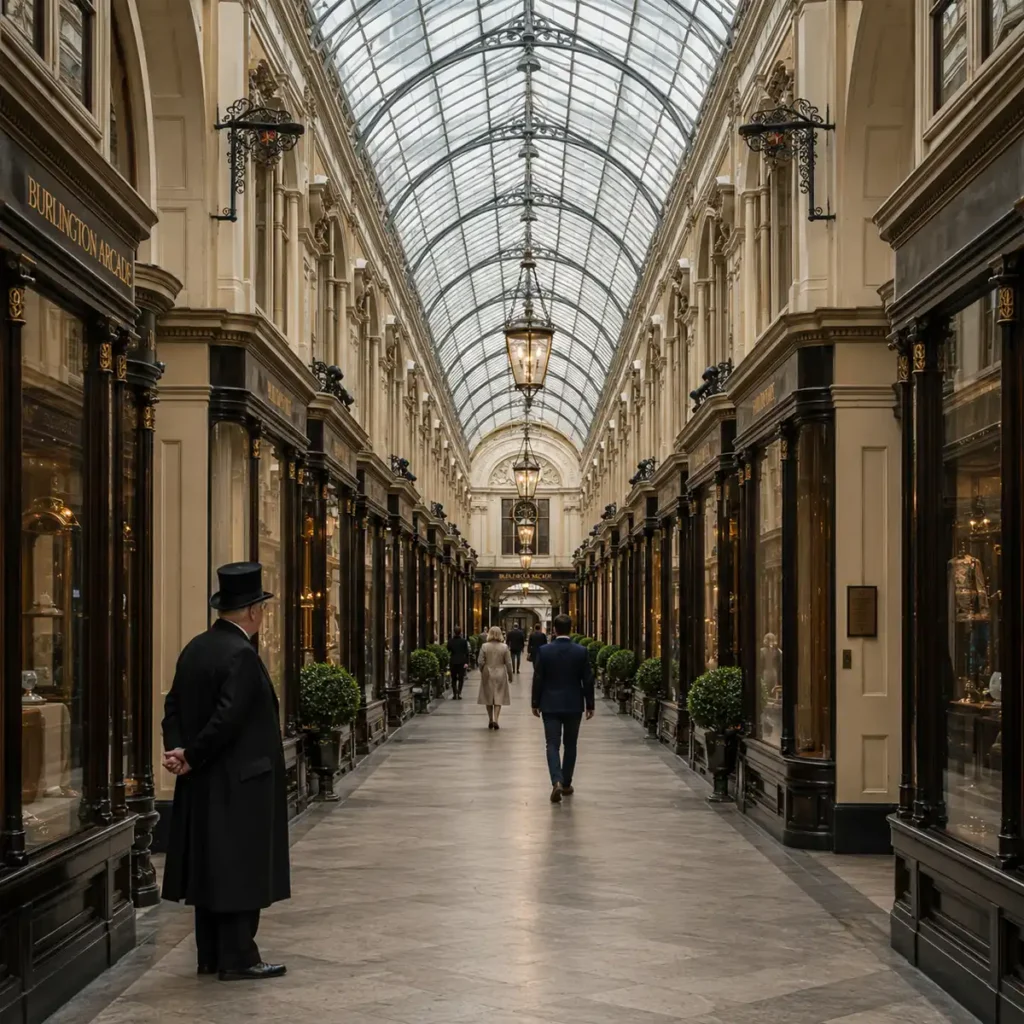
In 1819, Lord George Cavendish had a specific problem. The residents of Burlington House on Piccadilly were tired of being harassed by pedestrians crossing their estate from the street toward the fields to the north. The covered arcade he commissioned as a barrier was not designed as a shopping destination. It was designed as a territorial boundary: 72 yards long, roofed in glass, lined with single-fronted shops to generate the income that would pay for its maintenance. Burlington Arcade in Mayfair has been one of London’s finest retail environments ever since, which is one of the stranger outcomes in the history of West End planning.
The Arcade has 44 shops today. The Beadles, private uniformed officers in Regency-period frock coats and top hats, still enforce a code of conduct that prohibits whistling, hurrying, and carrying open umbrellas inside the building. The code is genuinely enforced. Visitors who walk through Burlington Arcade at speed, scanning windows as they pass, are using it incorrectly. The Arcade was designed for a different pace, and the pace it was designed for is still the one that produces the best results.
As of spring 2025, the tenant mix within Burlington Arcade has consolidated around heritage retail and independent specialists. Several international fashion brands that occupied units between 2015 and 2020 did not renew their leases, and new tenants in 2024 and 2025 have predominantly been bespoke and craft-oriented businesses, a shift that has returned the Arcade closer to the commercial identity it carried in its first century.
What the Arcade Was Built for and What It Became
Burlington Arcade is a Grade I-listed covered shopping arcade running from Piccadilly south to Burlington Gardens in W1J, directly behind the Royal Academy of Arts. It was constructed in 1819, making it older than the Metropolitan Police by a decade. The building’s glass barrel vault, Regency shopfronts, and stone floor are intact. The Arcade operates Monday to Saturday from 9 am to 7.30 pm and Sunday from 11 am to 6 pm.
Entry is free. No reservation is required to enter the Arcade itself. Individual boutiques have their own appointment protocols; the bespoke services within the building, particularly shoemaking, typically require prior contact by telephone before a visit.
Where the Arcade Excels by Category
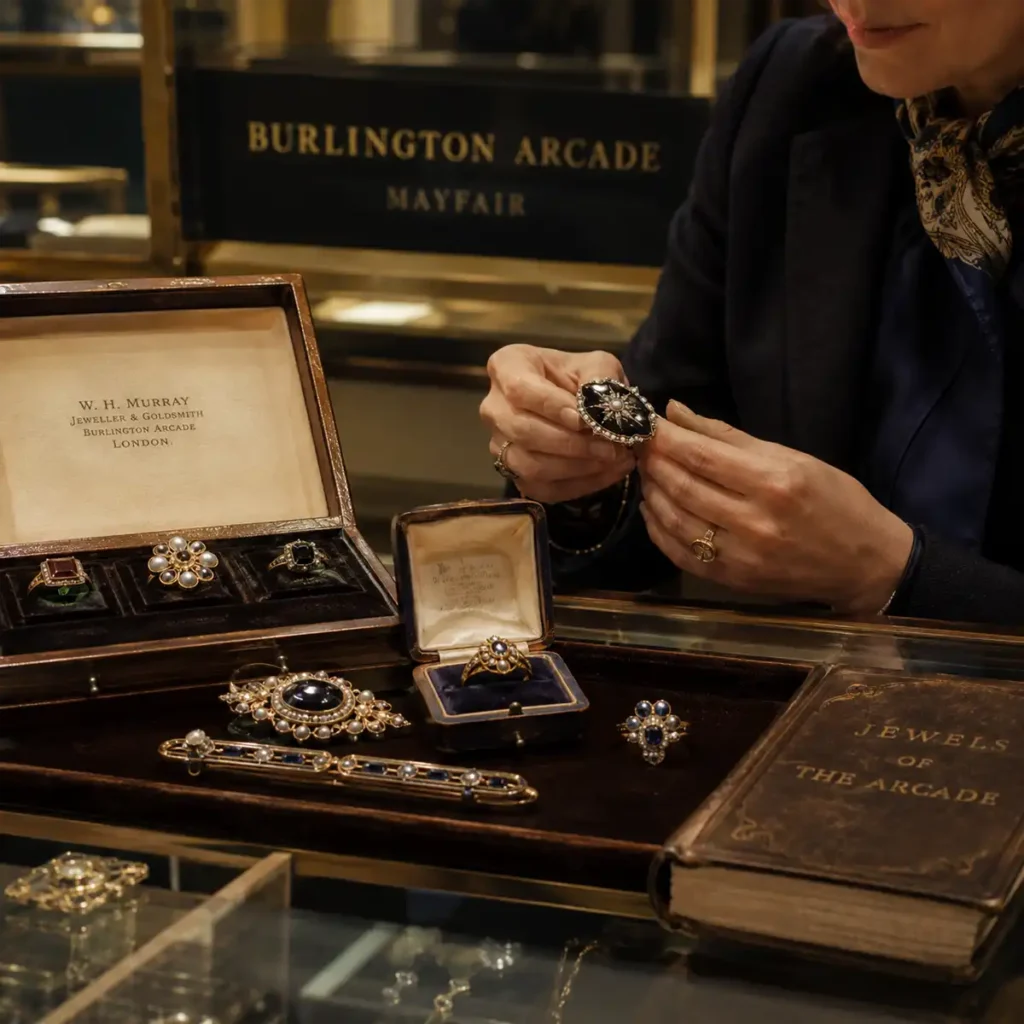
Jewellery is the category in which Burlington Arcade most clearly outperforms the wider Bond Street offer. Hancocks, founded in 1849 and occupying its Arcade position since the 1850s, specialises in antique and estate jewellery and is particularly strong on Victorian, Edwardian, and Art Deco pieces. The window displays are curated with a precision that reflects a century and a half of working with serious collectors. Richard Ogden at the Arcade’s southern end holds comparable strength in antique rings and signed pieces; no appointment is necessary for a first visit.
Cashmere is the Arcade’s second consistent strength. N Peal, whose main entry is at the Burlington Gardens end, is the largest cashmere specialist in the district. The floor space is greater than the shopfront suggests, and the range of weights, finishes, and colours is broader than any other single address within walking distance of Bond Street station.
Hemming and Sons, the bespoke shoemaker at the Piccadilly end of the Arcade, takes commissions from a last created by hand measurement and produces shoes across a period of 8 to 12 months. The price for a first pair begins at approximately 3,200 pounds. Telephone the workshop before visiting if a commission is the purpose of the trip; the team works primarily by appointment.
Fun fact: Burlington Arcade’s Beadles are a direct institutional continuation of the private constabulary that Lord Cavendish appointed in 1819, predating the Metropolitan Police, which was established in 1829, by a decade. They hold no formal police powers but have been removing rule-breakers from the Arcade continuously for over 200 years.
How to Move Through the Arcade
The correct approach: enter from the Piccadilly end in the morning, before the tourist volume builds, and walk south toward Burlington Gardens at the pace the building was designed for, which is slower than a street. The glazed roof produces a quality of light that rewards the pace; windows that look narrow from a moving perspective open considerably at a stop. Allocate a minimum of 45 minutes if the intention is to enter 2 or 3 shops, and a morning if a commission or a significant purchase is planned.
The Beadles are not decorative. They know every tenant in the building and can direct a visitor to the correct specialist with a description of the category rather than the specific name. Do not pass them without speaking. The exchange takes 30 seconds, and the resulting directional information is more precise than any map of the Arcade published online.
Burlington Arcade Within a Wider Bond Street Day
The Arcade sits between Old Bond Street to the east and Piccadilly to the south, making it a natural point of transition within a longer Mayfair shopping programme. The sequence that works: New Bond Street in the morning for flagship fashion and authorised dealer watches, Old Bond Street next for Asprey and the jewellery corridor, then the Arcade from the Piccadilly entrance for independent specialists and the quieter register that the larger boutiques cannot offer. After the Arcade, Brook Street and South Molton Street extend the independent offer toward Brown’s Hotel on Albemarle Street.
Anyone treating the arcade as one stop on a longer walk will find it sits within a few minutes of most of Mayfair’s best known landmarks.
The contrast with the mass-market end of the same district is stark, and the M&S Marble Arch redevelopment has become the test case for what Oxford Street becomes next.
Bond Street station, served by the Elizabeth line and the Jubilee line, is a 10-minute walk from the Piccadilly entrance of Burlington Arcade. Green Park station on the Victoria, Jubilee, and Piccadilly lines is a 7-minute walk from the Burlington Gardens exit.