With renovation spend at record highs and disruption costs rising, covering rather than replacing trim is one of the smartest moves in the modern renovation toolkit
More than half of UK homeowners renovated their properties in 2024 – up from 48 per cent the year before – at a median spend of over £21,000, according to the 2025 Houzz & Home Report. At the same time, 33 per cent of UK homeowners are choosing to delay moving and improve their current home instead. The improve-rather-than-move trend is no longer a response to a single economic shock. It has become the default mode of British homeownership.
With that shift has come a sharper focus on where renovation budgets actually go – and where they quietly disappear. Kitchens and bathrooms get the headlines. The finishing details do not. And yet it is the finishing details – skirting boards, architrave, the trim around every door and along the base of every wall – that most noticeably define whether a renovated room looks complete or unfinished.
There is a growing category of products that addresses this gap directly. And it is one that most homeowners, and a surprising number of trade professionals, do not know exists.
The problem with trim in a mid-renovation home
Replacing skirting boards and architrave sounds straightforward. In practice, it rarely is.
Existing boards are often firmly bonded to the wall with years of paint and adhesive. Removing them risks pulling plaster, cracking the wall surface, and creating a repair job that adds cost and time before a single new board goes up. In a home where new flooring has already been laid – which is the situation for a significant proportion of renovation projects, where floor work typically precedes decorating – removal also risks damaging the new floor covering in the process.
The result is a familiar renovation compromise: homeowners spend tens of thousands on a project, reach the trim stage, and either live with the existing skirting and architrave or take on a removal job that cascades into unexpected costs. Nine in ten homeowners who renovated in 2024 encountered unexpected expenses during the work, with the price of materials and uncovering issues during the work among the most common causes. Trim removal sits squarely in this category.
A simpler approach
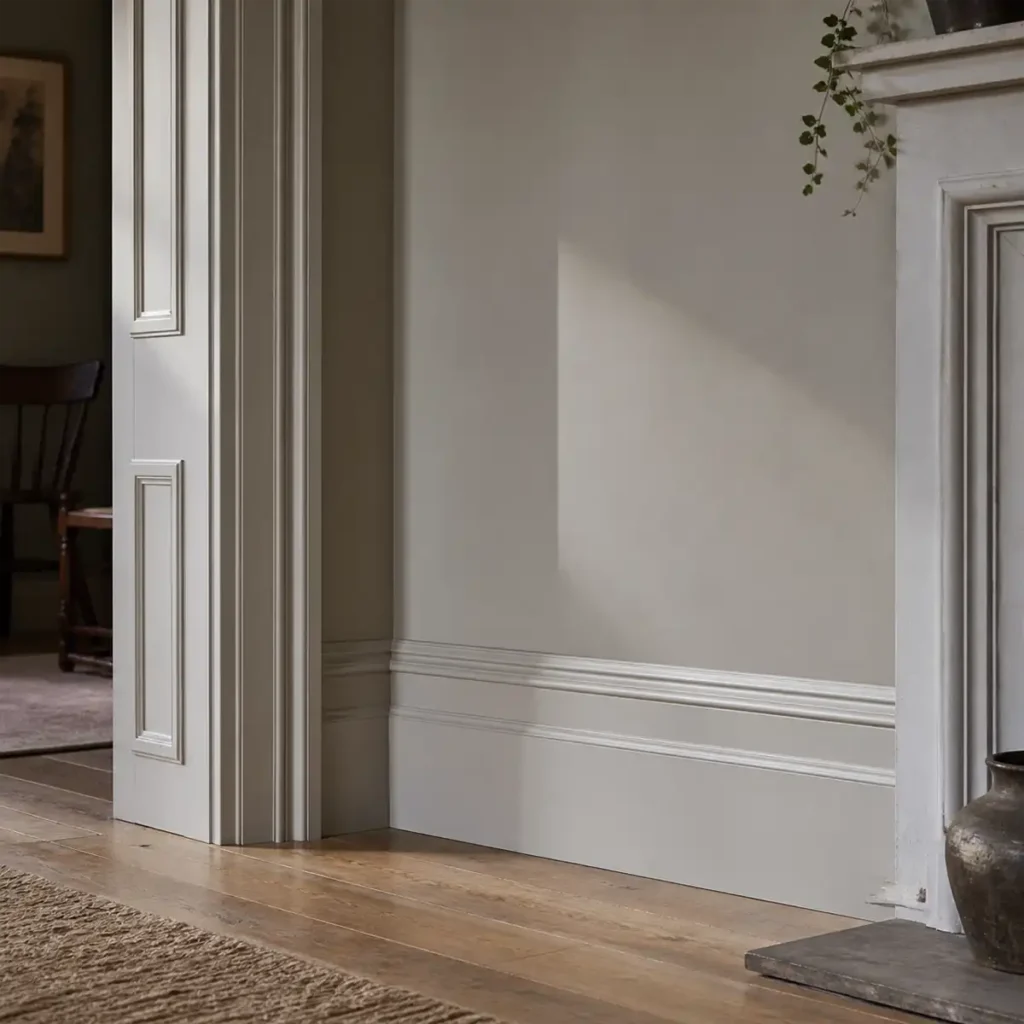
Skirting board covers have existed as a product category for some time – a primed MDF profile machined with a rebated back edge, designed to bond directly over the existing skirting board without removal. The result, once painted, is indistinguishable from a full replacement. No plaster damage, no floor risk, no making good.
What is newer is the application of the same logic to architrave. Adam McGrory, a director at MDF mouldings supplier MR Mouldings, has recently launched a dedicated range of architrave covers – traditional, modern, and hockey stick profiles – designed to fit directly over existing door architrave in the same way.
“The question we hear constantly is whether you have to remove the old architrave or whether you can go over it,” McGrory says. “The answer, in most cases, is that you can cover it – and the result is at least as good as a full replacement, often better, because you are not dealing with the plaster damage and repair work that removal almost always creates.”
The timing reflects a broader shift in how renovation projects are being managed. With labour costs rising – construction wages grew around 4.7 per cent year on year in 2023, according to industry data – the cost of any task that requires skilled time on site has increased significantly. A task that can be removed from the job entirely without compromising the result is worth taking seriously.

Who it works for
The cover approach is not universally applicable – if the existing trim is structurally compromised, loose, or rotten, removal and replacement is the right call. But for the large proportion of homes where the trim is sound but visually dated or surface-damaged, it is a genuine alternative.
The scenario where it works best is also the most common one in the current renovation cycle: a homeowner who has bought a period or older property, completed significant work on the main rooms, and is now addressing the finishing details. The skirting boards are original – solid, firmly fixed, probably painted over many times – but the wrong profile for the renovation that has just happened around them. The architrave around the doors is chipped and tired. Ripping it all out means another week of disruption at the end of a project that has already run longer than planned.
A cover profile fitted over the existing trim, sanded, caulked, and painted, resolves the problem in a day.
Profile choice matters
One thing cover products share with standard trim is that profile selection determines how well the result reads in the finished room.
For period properties – Victorian and Edwardian homes with higher ceilings and original moulding details – a traditional ogee profile on both the skirting cover and the architrave cover gives the most coherent result. For modern and new-build interiors, a flat modern profile or hockey stick cover matches the minimal aesthetic that most contemporary rooms are built around.
The hockey stick profile deserves particular mention. It is the standard architrave profile in the vast majority of new-build homes built in the UK over the last three decades, and it chips and scuffs more easily than heavier profiles. A hockey stick cover that fits directly over the existing profile is, for many new-build owners, refreshing a tired interior, the cleanest possible solution.
The broader logic
With 53 per cent of renovating homeowners residing in homes built in 1940 or earlier, repairs and upgrades to ageing fabric are a key focus of the current renovation cycle. Much of that ageing fabric is the trim – the skirting, the architrave, the accumulated layers of paint and filler that make a period property feel tired even after significant investment elsewhere.
The instinct is to rip it out. Often, that is not necessary. And as renovation budgets are stretched further and the cost of unexpected disruption becomes more visible, the smarter question is not how to remove the old trim – but whether you need to.
Sources
- 2025 UK Houzz & Home Study – renovation activity and median spend data
- Home Improvement Statistics UK 2026, Primethorpe Paving – improve rather than move statistics
- More than half of UK homeowners renovate instead of move amid cost pressures, Insider Media