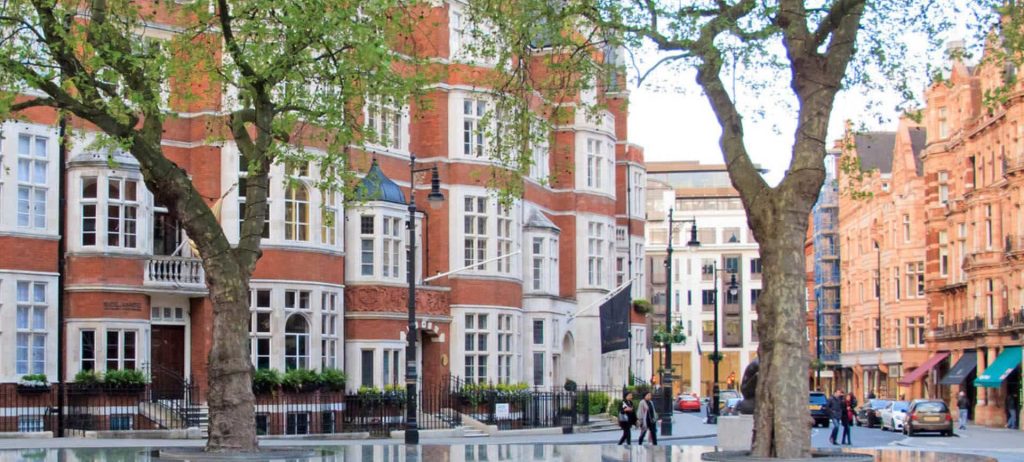
The Fenwick Bond Street store closed its doors in February 2024, ending more than 130 years of trading on the same stretch of Mayfair. More than two years on, people still search for it, still arrive at 63 New Bond Street expecting to find it, and still ask what went wrong. The short answer is that nothing went wrong inside the shop. Fenwick Bond Street closed because the building underneath it had quietly become worth far more than the business trading within it.
That distinction matters, because the closure has been read ever since as a verdict on Mayfair retail. It was not. It was a property decision, taken by a family that had owned the site for generations and could see exactly what it had become worth.
It is worth being precise about which shop closed, because the name still appears against New Bond Street in older directories and in mapping data that has never been updated. The store stood at 63 New Bond Street, on the western side, a few minutes from Oxford Street. That address is now hoarded off.
A closure that had been coming for years
The Fenwick family sold the New Bond Street building to Lazari Investments for £430 million. Once that number was on the table, the arithmetic stopped being about retail margins and started being about square footage. No department store trading on that footprint could generate a return to justify holding an asset of that value.
The group itself did not disappear. Fenwick continues to trade, with its flagship in Newcastle, where the business was founded. What ended in February 2024 was a single branch, albeit the one that carried the name into every London shopping guide printed in the last century.
Shoppers who had used the store for decades described the loss in terms that had little to do with price. It was the sort of shop where a member of staff would find the thing you could not find anywhere else. That kind of trading is difficult to measure and almost impossible to defend on a spreadsheet against £430 million.

Why the site commanded that price
New Bond Street carries the highest retail rents in Britain and ranks second in the world. A department store, by design, gives over enormous floor area to circulation, display and departments that break even at best. A luxury house occupying a fraction of the same frontage will pay more per square foot and ask for less space.
The economics of the street now favour the specialist over the generalist, and have done for some time. A single brand can turn a modest shopfront into a global flagship, treat it as advertising as much as retail, and absorb a rent that no multi-department operator could carry.
Fenwick Bond Street was the last survivor of an older model on that street. Its closure did not start the shift towards single-brand luxury. It confirmed that the shift was finished.
What is going into the site
Lazari Investments commissioned Foster + Partners for a deep retrofit of the building rather than a demolition. The scheme creates expanded retail space at street level with office floors above, keeping the structure while rebuilding what it can hold.
The retrofit approach matters in a conservation area. Mayfair planning policy makes wholesale replacement of a building of that scale extremely difficult, so reworking the existing envelope is usually the only route that gets consent. It also means the street elevation people recognise is not going anywhere.
In the interim, part of the store found an unexpected second life. Charity Super.Mkt took space for pop-up charity shops from February 2024, filling the ground floor of one of the most expensive retail addresses in Europe with donated stock. For a few months, the most exclusive shopping street in London had a genuine bargain in it.
No reopening date has been published for the completed scheme, and the developer has not named tenants. Anyone expecting the Fenwick Bond Street name to return above the door will be disappointed, because the family sold the freehold outright rather than leasing it back. The building will keep its outline and lose its identity.
Fenwick was not the only departure
Within weeks, Smythson announced it was leaving New Bond Street too. The 137-year-old stationer had returned in 2017 to the address where it began in 1887, and closed the shop to cut costs and protect the rest of the business. Mulberry had already gone.
Three departures in quick succession from the same street invited a simple explanation, and two candidates were offered repeatedly. Tourist numbers had not recovered to their previous levels. The removal of VAT-free shopping for overseas visitors had pushed a meaningful share of high-value spending to Paris and Milan, where the refund still applies. Our index of Europe’s luxury districts measures how much of that spending moved and where it landed.
Both are real pressures. Neither fully explains the pattern, because the same street kept attracting new arrivals throughout. Houses were opening flagships on New Bond Street in the same period that others were closing, which is not what a street in decline looks like. What changed was the type of tenant that could make the numbers work.
What the street looks like now
The businesses that have held their ground are the ones selling something that cannot be replicated online or bought more cheaply elsewhere. Craft, scarcity and service have turned out to be the qualities that survive a rent review.
Swaine is the clearest example. Founded in 1750, it still sells umbrellas, bridle leather cases and luggage made to a specification that has barely moved in two centuries. There is no volume argument for that business. There is a very strong argument for being the only place that does it properly.
The same logic applies at the other end of the price scale. Harry Winston occupies a fraction of the floor area Fenwick once held and needs every inch of it to do considerably less work, because a single stone can justify the address on its own.
Between them sit the watch boutiques, the galleries and the specialist dealers who have replaced the department store model entirely. The street sells fewer categories than it did in 1990 and sells each of them to a far higher standard.
That concentration has a cost for shoppers. Comparison across brands used to happen inside one building, on one floor, in an afternoon. It now happens on foot, boutique by boutique, with an appointment for anything serious. The trade did not leave the street. It simply stopped being possible to do all of it under a single roof, which is precisely what the Fenwick Bond Street building had offered since the Victorian period.
What the closure actually tells us
Read as a warning about Mayfair retail, the closure of Fenwick Bond Street is misleading. Read as a property story, it is completely legible. A family sold a building for what a developer would pay, a developer is rebuilding it for the tenants who can afford the street, and the trade that could not carry the rent has moved on.
What was lost was real. A department store is a public room as much as a shop, somewhere you can walk through without buying, and New Bond Street has one fewer of those. The retrofit will bring back retail at street level, but it will bring back boutiques rather than a shop floor you can wander.
The departures were only half the story, and the arrivals that replaced them have been steadier than the headlines suggested.
For anyone still searching for the Fenwick Bond Street store, the practical answer is that the nearest Fenwick is now in Newcastle, and 63 New Bond Street is a building site behind a retained facade. The street around it is trading perfectly well without it.