
The story that gets told about Mayfair retail is one of departures. Fenwick gone, Smythson gone, Mulberry gone. What that account leaves out is the other column of the ledger, because the run of Bond Street openings over the same period has been one of the heaviest in the street’s modern history. The houses behind those Bond Street openings have been signing leases at record rents while the obituaries were being written.
Both things are true at once, and the reason is the same in each case. The rent only works for a certain kind of business now. Those that fit have been arriving steadily. Those that do not have been leaving.
Anyone tracking New Bond Street through this period will have watched hoardings go up on one building while another came down two doors along. It has made the street difficult to read from a single visit.
The flagships that landed
Gucci took a substantial New Bond Street building for a flagship running to several floors, moving off Old Bond Street to do it. The scheme was built around fewer, larger spaces with room for made-to-order services rather than the shop-and-leave format the street used to run on.
Louis Vuitton reopened its New Bond Street Maison after a lengthy closure, and Fendi completed a rebuild of its own flagship that took two years. A. Lange und Sohne opened a four-storey boutique at 29 Old Bond Street, which for a watchmaker of that size is a very large bet on one address.
None of those is a small commitment. Each of them was signed after the tourist-tax change that supposedly emptied the street, which tells you the brands doing the signing are working from a different set of numbers than the commentary is.

What the big houses are actually buying
A flagship on this street is not primarily a shop. It is the physical proof that the brand belongs in the same sentence as its neighbours, and it is photographed, filmed and linked to constantly without the brand paying for any of it.
That is why the recent Bond Street openings run to four and five floors when the trading area needed is one. The upper levels hold private salons, appointment rooms and made-to-order services for the clients who account for most of the revenue and none of the footfall.
It also explains why the arithmetic that finished the department store does not trouble a single-brand house. One is trying to earn a return per square foot. The other is buying a global address and treating the shop as the smaller half of what it gets.
The independents that came with them
The more interesting Bond Street openings are the smaller houses, because they have no advertising budget to justify the rent and have to trade their way to it.
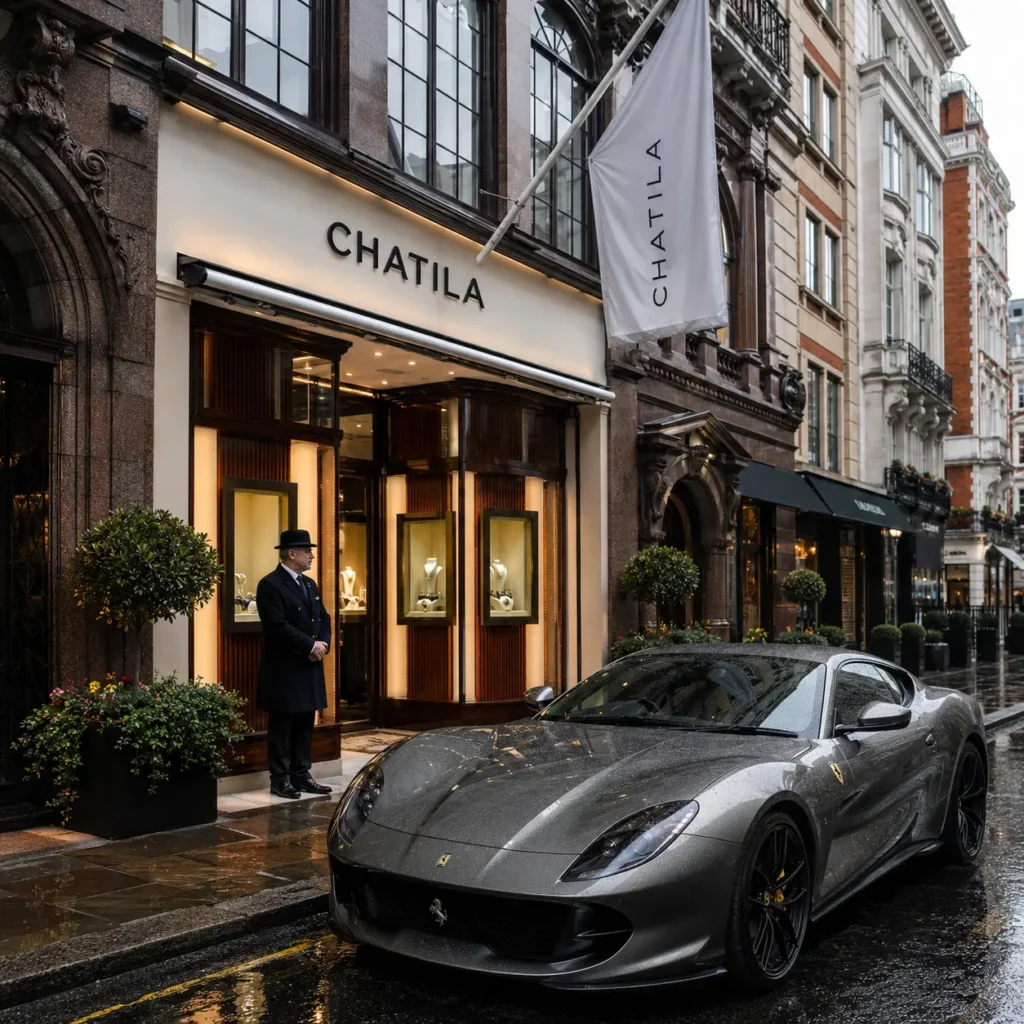
Chatila is the clearest case. Founded in Beirut in 1860, it makes high jewellery at a level where a single commission can carry a quarter, and it has taken an Old Bond Street address alongside brands many times its size. That works because the client for an emerald of that quality is looking for a house, not a logo.
At the other end of the same trade, Kismet by Milka sells stacking rings and ear stacks designed to be bought a piece at a time and worn together. It is fine jewellery priced for repeat purchase rather than for the once-in-a-decade occasion, which is a genuinely different proposition on a street built around the latter.
Both of those are the pattern that matters. A specialist with something particular to sell can now hold an address that a general retailer with far greater turnover cannot.
What the arrivals have in common
Look across the recent Bond Street openings and a consistent shape appears. Almost every one of them sells something that requires the buyer to be present.
High jewellery has to be seen under the right light and against the wearer’s skin, and no photograph settles the question. Made-to-order tailoring requires measuring. A watch has to go on a wrist. Fragrance cannot be assessed any other way at all. These are the categories where the shop is not an inconvenient overhead but the actual mechanism of the sale.
The businesses that left the street sold things that do not need any of that. A department store’s largest departments were beauty, accessories and womenswear at a price point where the customer already knew the product, and every one of those categories moved online faster than anyone in the trade expected.
That is the real dividing line, and it explains the pattern better than tourist numbers or tax policy do. Bond Street has become a street of purchases that cannot be completed on a phone. Everything that could be has already gone.
The rent figures behind all of this are worth stating plainly, because they explain decisions that otherwise look irrational.
New Bond Street carries the highest retail rents in Britain and ranks second globally, a position set out in our ranking of Europe’s luxury districts. That places it above every street in Milan, above most of Paris, and within reach of the very top of Fifth Avenue. A tenant signing here is competing for space against the strongest brands on earth.
Two consequences follow. The first is that lease lengths have shortened at the margins, with more short-term and pop-up activity between long-term tenants, which adds to the impression of churn. The second is that the tenant mix has become self-selecting. Only businesses with either enormous margin or enormous brand value can bid, so the street increasingly contains only those two kinds of business.
It is worth adding that the landlords are patient in a way high-street landlords are not. Much of the surrounding estate is held long term by institutions that will leave a unit empty rather than let it cheaply and damage the tone of the street. An empty shopfront in Mayfair is often a choice rather than a failure to let.
Why the street reads as emptier than it is
Part of the perception gap is simple mechanics. A department store closing removes one tenant and leaves a hundred metres of hoarding. Four Bond Street openings add four tenants across four discreet shopfronts that nobody photographs.
Refits make it worse. A flagship rebuild takes eighteen months to two years, and for most of that the site looks abandoned. At any given moment several of the street’s best addresses are behind boards, and the casual impression is of decline rather than reinvestment.
The other part is that the retail mix genuinely narrowed. There are fewer categories on Bond Street than there were thirty years ago. Jewellery, watches, fashion houses and galleries now account for most of the frontage, and the shops that once filled the gaps between them have gone. Fewer kinds of shop is not the same as fewer shops, but it feels like it on foot.
What to watch next
The Fenwick site is the one to follow. When that retrofit completes it will release a large block of new retail at street level, and whoever takes it will say a great deal about where the street thinks it is heading. Several boutiques would confirm the pattern. A single large tenant would break it.
Beyond that, watch the arcades and side streets. Rents on the main run have pushed a whole tier of interesting businesses into Burlington Arcade, the Royal Arcade and the streets behind, and some of the best trading in Mayfair now happens fifty metres off Bond Street rather than on it.
Watch the smaller jewellers too. A house like Kismet by Milka holding a New Bond Street address on repeat-purchase pricing rather than on once-a-decade commissions is the sort of Bond Street opening that would have been impossible fifteen years ago, and there are now several of them.
The pattern in the recent Bond Street openings is consistent enough to predict from. Brands that can turn a shop into advertising will keep paying whatever the street asks. Specialists with something nobody else makes will keep finding a way in. Everyone in between will keep being priced towards the arcades, and the street will keep looking quieter than its rent roll suggests.


