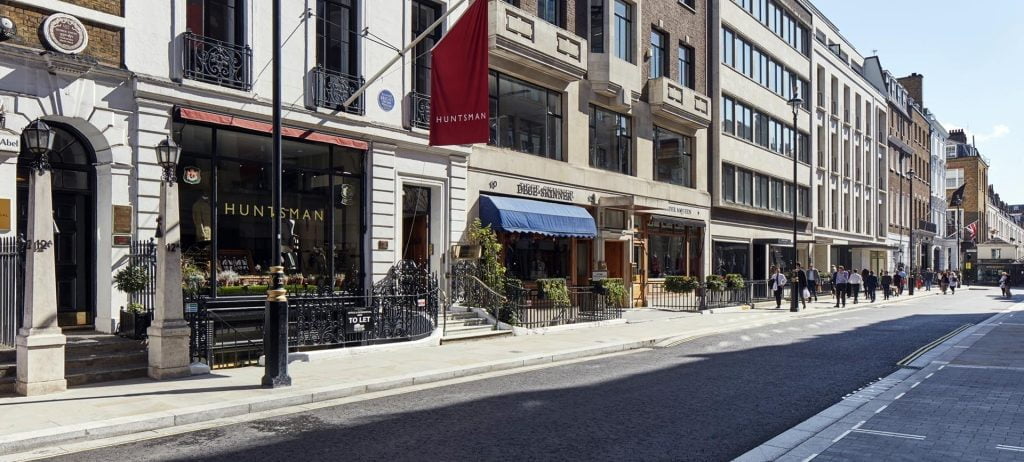
Five private members’ clubs sit inside a few hundred metres of one another in Mayfair, and the widest gap between any two of them is a walk of under 9 minutes. Harry’s Bar on South Audley Street to the Arts Club on Dover Street is 561 metres. Nothing on any of those frontages tells you what is behind it.
That is the first thing to understand about old money in this part of London. The buildings are not hiding because the people inside are ashamed of them. They are hiding because visibility is the thing being avoided. Our directory lists the district’s members clubs with their addresses, which is more than most of them publish themselves.
The second thing is stranger. Almost the entire modern Mayfair club estate was built by one man, working out of one basement, and that basement sat directly underneath a gaming room.
What old money actually means in Mayfair
In Mayfair, old money London describes a set of behaviours rather than a level of wealth. It means membership obtained by proposal rather than payment, venues that do not advertise, dress that signals nothing in particular, and a strong preference for transactions that leave no public record. Money is assumed. Discretion is the currency.
The geography follows the same logic. Mayfair sits in W1, inside the City of Westminster, and the clubs cluster on its quieter streets rather than its retail ones. The Arts Club at 40 Dover Street is about 4 minutes on foot from Green Park station. Annabel’s at 46 Berkeley Square is about 6. Neither is on a street anybody walks down by accident.
The rest of the group holds the same pattern. 5 Hertford Street occupies 2 to 5 Hertford Street, George sits at 88 to 89 Mount Street, and Harry’s Bar at 26 South Audley Street. Four of the five are on residential streets. That is not an accident of property availability.
The assumption that gets this wrong
The common reading is that old money spends heavily and quietly, and that the quietness is a kind of taste. That is roughly half right and it misses the mechanism entirely. Old money is not a spending pattern. It is an admissions policy.
The clubs are not expensive by the standards of the people in them. A membership at one of these houses costs less annually than a single evening at several of the restaurants on the same street. Price is not the filter and was never designed to be, because price admits anybody who can pay, which is precisely the outcome old money exists to prevent.
The filter is the proposal. Somebody already inside has to put your name forward and stand behind it. That person carries the cost of your behaviour, which is a far more effective screen than a fee, and it cannot be bought at any price by somebody nobody knows.
This is why the interiors look the way they do. Worn leather, dark panelling and portraits are not nostalgia. They signal that nothing here needs refreshing to attract anybody, because nobody is being attracted.
One basement, and the estate it built
On the evening of 4 June 1963, a party opened a club in the vaults beneath 44 Berkeley Square. Mark Birley had taken the basement on the suggestion of John Aspinall, whose Clermont Club occupied the floors above. Birley named the place after his wife, Lady Annabel.
The arrangement is worth pausing on. One Georgian townhouse held a licensed gaming room upstairs and the most exclusive nightclub in Britain downstairs, run by two different men, serving substantially the same old money crowd on the same evening. You could lose a considerable sum on the first floor and be dancing under it twenty minutes later without stepping outside.
Annabel’s stayed in that basement for 55 years and moved to number 46 in 2018. Lady Annabel’s own account of that period is covered in our piece on her Mayfair legacy.
Fun fact: Birley went on to open Mark’s Club in 1972, Harry’s Bar in 1979 and George in 2001, so most of the district’s private club estate traces back to one man and one basement.
How you actually get through the door
Entry to a Mayfair private club runs on proposal and seconding. An existing member puts your name forward, a second member supports it, and a committee decides. Waiting periods of a year or more are normal at the older houses, and applying without a proposer is not a slower route in. It is not a route at all. This is the single mechanism that keeps old money closed, and it has not changed in 200 years.
What follows admission is a set of rules that nobody hands you in writing. Phones stay in pockets in most rooms and are prohibited outright in some. Photography is not done. Business papers on the table are frowned on at several houses, and in a few they will be quietly removed.
Guests are the member’s responsibility in a way that is meant literally. Bring somebody who behaves badly and the committee’s conversation is with you, not with them. That single rule does more to maintain the atmosphere in these rooms than any dress code.
Dining follows the same grammar. Reservations at the better tables on Mount Street are made by telephone to a manager who recognises the voice, not through an application, and the good tables are allocated by relationship rather than by how early you asked.


The private room and the public register
Every old money instinct described so far points one way, which is away from records. That instinct now runs directly into how regulated gambling in Britain is built, because the modern system is a register by design.
Since 31 March 2020, every online operator licensed in Great Britain has been required to participate in GamStop, the national self-exclusion scheme. Since 28 February 2025 those operators must run a financial vulnerability check once a customer’s net spend passes £150 in a rolling 30 days. A statutory levy on licensed operators followed on 6 April 2025, charged at between 0.1% and 1.1% of revenue.
Each of those measures works by knowing who you are and what you did. Directories listing UK gambling sites not on GamStop cover operators licensed elsewhere, outside the domestic scheme and outside its record-keeping. The appeal to a certain temperament is obvious, and it is worth being clear-eyed about what is actually being traded.
The protection and the record are the same object. You cannot decline one and keep the other. If you have used GamStop deliberately, the whole value of it depends on not going around it, and free confidential support is available through BeGambleAware.
Old money in Mayfair solved this differently and, on the evidence, better. A private room keeps no public record, but it is full of staff who have watched the same people for years. Discretion outward, memory inward. That combination is the thing the online market has never successfully copied.
Old money in the West End was never really about avoiding scrutiny. It was about choosing who does the scrutinising, and preferring a person who knows you to a system that does not.
If you want to see the world this describes, do not start by trying to join anything. Walk Hertford Street, Mount Street and South Audley Street on a weekday evening and count the doors you would have walked past without noticing. That number is the entire argument.
The way in, when it comes, arrives as an invitation from somebody who already trusts you. Everything else in old money London is downstream of that.