Walk from Bond Street station towards Burlington Arcade on a weekday morning and you pass more diamond stock than most British towns see in a decade. Very little of it is visible online. Mayfair’s jewellers have spent generations perfecting the appointment, the tray of loose stones, the loupe handed across a desk in a first-floor salon off Albemarle Street. What almost none of them built was a website that could show a buyer 200,000 diamonds at midnight.
That gap is now closing, and it is closing quickly. A new generation of diamond catalogue software lets a W1 jeweller publish live, priced, certificated inventory on their own domain without commissioning a bespoke development project. For buyers, it means the stone you see on screen at 11pm is the stone that exists in a vault in Antwerp. For jewellers, it means the shop window finally extends past Westminster, and that the reputation built over decades on Mount Street can finally be found by someone searching from Singapore.
What a Live Diamond Catalogue Actually Means for a Mayfair Buyer
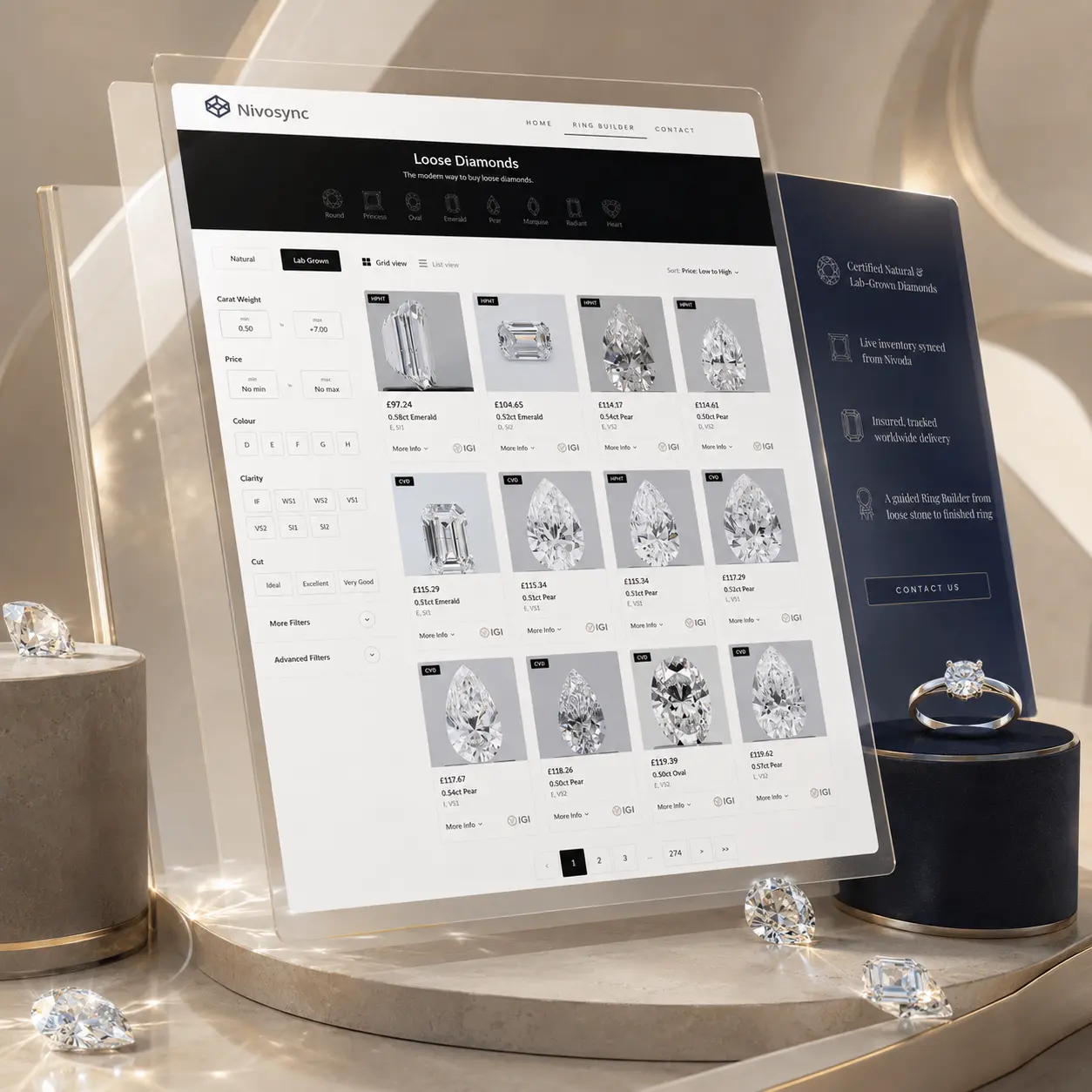
A live diamond catalogue is a searchable listing of stones that a retailer can sell but does not physically hold, pulled directly from a wholesale marketplace and priced with the retailer’s own margin. The stones are real, graded and available. The jeweller orders the one you choose only after you have committed to buy it.
This is a genuine change in how fine jewellery reaches the customer. Historically, a Mayfair jeweller showed you what was in the safe, plus whatever a trusted dealer could bring round within 48 hours. Selection was bounded by capital. A shop with £400,000 tied up in stock could show you perhaps 300 stones. The same shop running a live catalogue can present a searchable inventory in the hundreds of thousands, filtered by shape, carat, colour, clarity, cut, fluorescence and certificate number, without a penny of additional stock sitting in a drawer.
The practical benefit for buyers is comparison. You can hold a 1.20ct G VS1 oval against a 1.31ct H VS2 oval, see both certificate numbers, and understand exactly what the price difference buys you. That kind of side-by-side reasoning used to require three appointments across two postcodes.
Why Mayfair Held Out Longer Than Hatton Garden
Mayfair’s resistance to online catalogues was never technophobia. It was economics and positioning. A jeweller on Mount Street or in the Royal Arcade sells an experience as much as a stone, and the fear was that publishing a filterable grid of diamonds would reduce a considered purchase to a price comparison exercise.
There is also the matter of clientele. A significant share of Mayfair’s business is international, referral-led and appointment-only. When your buyer flies in for two days and has been introduced by a private client adviser, a public catalogue adds little. Hatton Garden, roughly 25 minutes east in the EC1N postcode, has always competed harder on visible price and volume, so it moved online first.
What changed the calculation was the cost of entry. Building a diamond catalogue from scratch has historically been quoted in the region of £15,000 to £40,000 by agencies just to connect the data, before any design work or ongoing maintenance. At that price, a boutique with 4 staff simply declined. Packaged plugin software has collapsed that number to an annual licence, which reframes the decision entirely.
How the Technology Works Behind the Shop Front
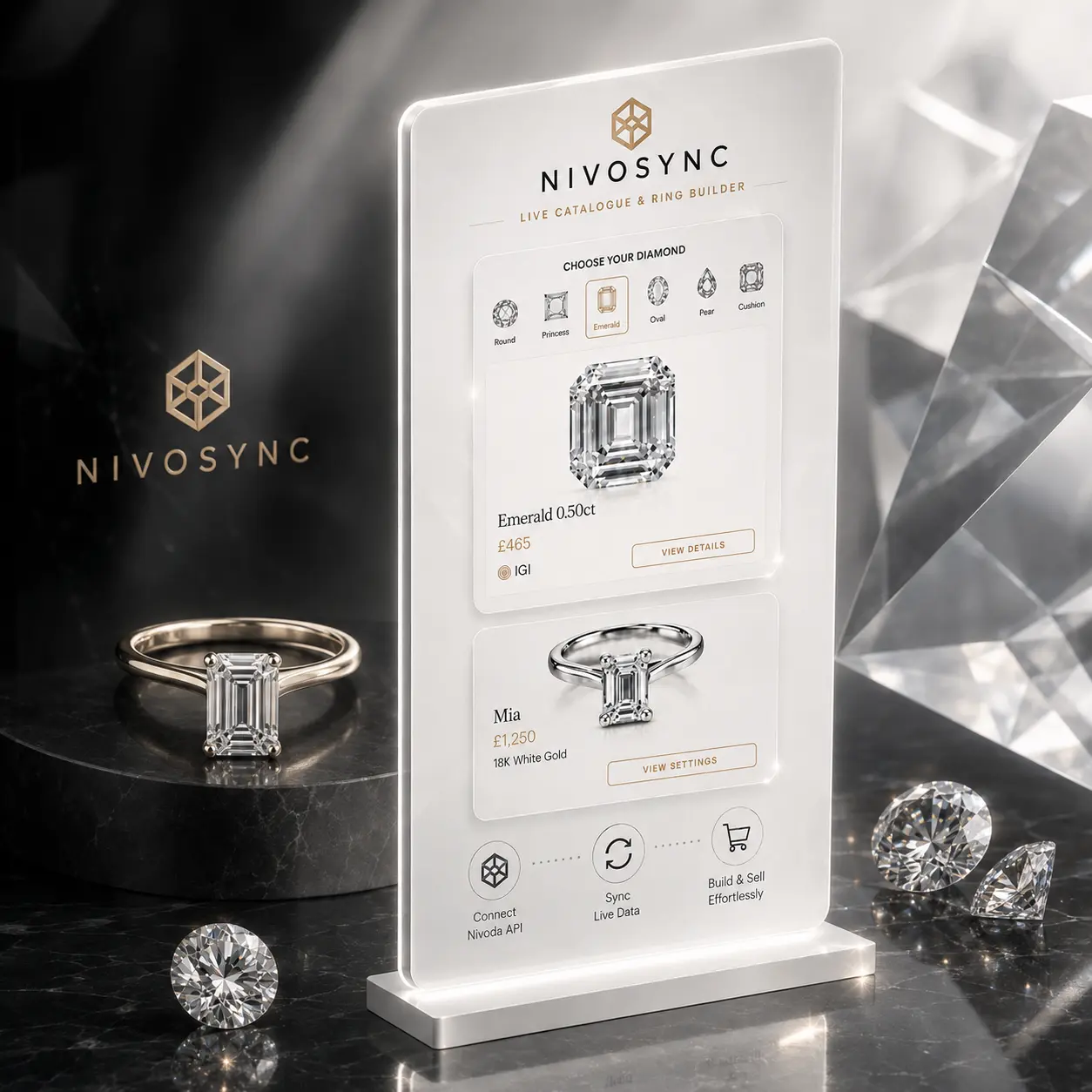
The mechanism is straightforward once the jargon is stripped away. A wholesale marketplace such as Nivoda aggregates stock from independent suppliers in India, Belgium, Israel and Hong Kong, and exposes that inventory through an API. A plugin installed on the jeweller’s WordPress site authenticates against that API, pulls the relevant stones into a local cache, applies the retailer’s markup rules, and renders the result as a branded, filterable catalogue.
Speed matters more than it sounds. A catalogue of 50,000 stones queried live on every page load would be unusably slow. The better implementations use a hybrid approach, serving the page from a local cache in under 200 milliseconds while a background request merges fresh pricing and removes stones that have sold. Tools such as NivoSync handle that caching layer, the pricing engine and the WooCommerce checkout as a single package, which is why an installation that once took a quarter now takes an afternoon.
One detail deserves emphasis for buyers. When a customer checks out, a well-built diamond catalogue places an automatic hold on that exact stone with the marketplace and releases it if the order is cancelled. Diamonds above roughly 0.50ct are effectively one-of-a-kind, so without that hold two customers could buy the same stone within minutes of each other. Ask any jeweller whether their system does this. It is the single most revealing technical question a buyer can put to them.
Fun fact: Burlington Arcade, opened in 1819, still employs Beadles in Edwardian frock coats who retain the authority to enforce rules dating from the Regency period, including a prohibition on whistling and running.
What This Means for Bespoke and Commissioned Work
Live catalogues have not displaced bespoke commissioning in Mayfair. They have reorganised where it begins. A customer who arrives having already shortlisted 3 stones online comes to the consultation with a working budget and a clear preference on shape, which typically saves 30 minutes of the first appointment and moves the conversation to setting, metal and design.
The bespoke process itself is unchanged. CAD rendering, wax carving, lost-wax casting, hand-finishing and stone-setting still happen in workshops, many of them still in Hatton Garden, on lead times commonly quoted at 6 to 8 weeks. What the catalogue changes is the centre stone decision, which is usually the largest single line in the quote and the one buyers find hardest to judge.
The district’s most exclusive houses remain untouched by any of this, and deliberately so. When Viren Bhagat opened an appointment-only salon in Mayfair, the proposition was the opposite of a searchable grid. That end of the market sells scarcity, and scarcity does not benefit from a filter panel. The catalogue model addresses the much larger tier below it, where buyers want reassurance that they have seen the field before committing.
Jewellers who have adopted the model well tend to pair it with a ring builder, letting a customer combine a chosen stone with one of the house’s own settings and see a composed price. That approach is explored further in our look at how jewellers connect wholesale diamond data to a WordPress store. It works because the setting remains the jeweller’s own product, with their photography, their craftsmanship and their margin, while the stone is sourced on demand.
Questions Worth Asking Before You Buy From an Online Catalogue
Ask 5 things. First, is the stone certificated, and by whom. GIA, IGI, HRD and GCAL are the recognised laboratories, and the certificate number should be searchable on the issuing body’s own site independently of the retailer. Second, does the price shown include VAT and the setting, or is it the loose stone alone. Third, can you view the stone in person before final payment, and at whose cost if you decline it.
Fourth, what happens if the stone is unavailable when the order is placed. A retailer running a properly integrated catalogue will know within seconds. One running a stale spreadsheet may take 3 days to tell you. Fifth, ask about the hallmark. Any ring with a gold, platinum or palladium content above the statutory threshold must be hallmarked by a UK Assay Office, and the London Assay Office mark is the one most Mayfair pieces carry.
Your statutory protections apply in the ordinary way. The Consumer Rights Act 2015 covers goods that are faulty or not as described, and distance selling rules give a 14-day cooling-off period on most online purchases, though bespoke and personalised items are commonly excluded. Confirm in writing which category your order falls into before you pay a deposit.
Where Mayfair Goes Next
The direction is not towards Mayfair becoming Blue Nile. It is towards the catalogue becoming the front door and the salon remaining the room where the decision is made. Several W1 houses now run appointment booking directly alongside the catalogue, so a buyer who has shortlisted stones at midnight can hold a Thursday morning slot in the same session.
That combination plays to Mayfair’s actual strength. The district has never competed on price against volume retailers and has no reason to start. It competes on judgement, on setting quality, on discretion and on aftercare, including resizing, rhodium replating and insurance valuations. A live diamond catalogue simply removes the one disadvantage the district carried, which was that a first-time buyer researching at home had nothing to look at.
It also fits a broader pattern across W1 retail, where the friction of the first visit is steadily being moved online so the in-person experience can concentrate on what it does best. We examined that shift more widely in our look at the rise of frictionless shopping experiences in Mayfair, and fine jewellery is simply the last category to arrive.
Practical Next Steps for Buyers and Retailers
If you are buying, start online and finish in person. Shortlist 3 to 5 stones, note the certificate numbers, and book an appointment to see at least 2 of them side by side under the same lighting. Bring the certificates. Ask to see the stone against a comparison stone one grade above and one below, because clarity and colour differences that look decisive on paper are often invisible in a setting.
If you are a retailer weighing this up, the questions are narrower. Confirm your hosting meets the requirements, that your theme and payment gateway are supported, and that your wholesale account has access to enough supplier inventory to make the catalogue look credible on day one. Marketplace access is granted supplier by supplier, so a brand new account will show a thinner catalogue than an established one. Budget for photography of your own settings, because that is what will differentiate your listing from every other retailer showing the same stones.
Mayfair jewellers were right to wait until the technology was good enough to represent them properly. It now is. The district’s next advantage will belong to whoever pairs a serious online diamond catalogue with the consultation quality that made Bond Street worth visiting in the first place.