On a Thursday night in Mayfair’s Golden Quarter, Bocconcino’s spiral staircase becomes a steady procession. Couples peel away from the calm glow of the ground floor, hedge-fund teams close their laptops and slip into jackets, weekend visitors from new five-star hotels gather in the bar. Below, the lower ground room swells with light, live music, DJ sets and the kind of happy noise that tells you this is not a hushed temple of fine dining but a fully fledged vibe-dining experience in London, where food, drink and spectacle are carefully choreographed to work together.
Bocconcino has now been trading on Berkeley Street for more than a decade, a serious achievement in a postcode where new openings arrive with fanfare and vanish just as quickly. The restaurant began life as a Moscow import, an offshoot of a Tuscan pizzeria seen through the lens of Russian high luxury. Today, it operates as a distinctly London Italian, calibrated for diners who want strong cooking, a glamorous crowd and a room that feels alive until late. Where nearby ventures have stumbled, Bocconcino has quietly grown into a group with a Soho site, a seafood spin-off off and a slate of industry awards.
For diners, the proposition is clear. This is an Italian restaurant in Mayfair that offers wood-fired pizza and handmade pasta, serious wine, a club-like late service and an events calendar tuned to the London social season. Prices start with accessible pizzas around the £18 to £25 mark, moving through a £75 Antinori tasting menu and on to high-ticket wines that can reach £2,000 a bottle. It is a place where a business lunch, a birthday brunch, and a high-spending celebration can all sit under the same vaulted ceiling.
As Mayfair’s hotel inventory surges and competition on and around Berkeley Street intensifies, Bocconcino offers an instructive case study in how a restaurant can adapt to new demographics without losing its core character.
Location And Setting In Mayfair Golden Quarter
Bocconcino sits at 19 Berkeley Street, in the heart of the Golden Quarter, loosely bounded by Berkeley Square, Mount Street, Bond Street and Piccadilly. What was once a stretch of discreet offices and finance houses has evolved into one of the capital’s densest clusters of luxury hospitality. Today, the street links the formality of the Ritz and Piccadilly to the old money calm of Berkeley Square, with restaurants, private clubs and hotel lobbies lining the route.
The surrounding hotel landscape is undergoing a significant reset. Across Mayfair, around 757 new high-end rooms are being added to the market, the largest uplift for roughly a decade. New openings such as the Mandarin Oriental Mayfair and the 1 Hotel Mayfair have landed within metres of Bocconcino, bringing a fresh wave of affluent international guests. Many of these visitors are seeking restaurants near Mayfair hotels that combine recognisable luxury cues with a sense of place and entertainment.
This influx cuts both ways. More keys mean more potential diners but also more in house restaurants and bars competing for the same corporate budgets and weekend spend. The 1 Hotel Mayfair leans towards sustainability and wellness rather than a classic late night club restaurant model, which effectively hands Bocconcino a ready made audience of guests prepared to cross the street in search of high energy Italian food and live music. The result is a neighbourhood where location alone is not enough, and where only those venues that continually sharpen their offer maintain long-term relevance.
From Tuscan Origins To Mayfair Power Player
Bocconcino’s story begins not in W1 but on the Italian coast. The original inspiration came from Forte dei Marmi, a chic Tuscan seaside town whose relaxed pizzerias serve fashion editors, industrialists and families on holiday. Russian entrepreneur Mikhail Gokhner fell for that mix of simplicity and style, licensed the concept and launched Bocconcino in Moscow in 2006, building a small empire at a time when Italian food was an unambiguous status marker for the Russian capital’s moneyed classes.
The leap to London in 2014 was, initially, less sure-footed. Gokhner took a prime Mayfair lease and fitted out the site in line with Moscow’s expectations, with an emphasis on opulence, complex menus, and meticulously deferential service. The assumption that London’s wealthy diners would mirror Moscow’s proved misplaced. The early years delivered respectable but unspectacular trade. London guests cared less about maximalist menus and more about atmosphere, comfort and whether the room felt worth dressing up for on a Thursday night.
Two years in, Bocconcino executed a decisive pivot. The interior was warmed up and made more luxurious without tipping into parody. The lower ground floor was reimagined around a large bar, live musicians and later DJs. The focus shifted from formal fine dining towards experience-led hospitality in line with the best restaurants in Mayfair that have leaned into music, performance and late hours. The change worked. Gokhner has since said that profit margins at the Mayfair flagship climbed towards 20%, compared with around 12% in Moscow, and that one London site began to match the combined revenues of multiple Russian units.
By 2023, Bocconcino was confident enough to expand. A Soho outpost opened on Great Marlborough Street, with a curvier, more futuristic design and a clientele drawn from media offices and shoppers. Osteria Del Mare, a seafood-focused sister near the Strand, targeted theatre crowds and tourists. Industry awards followed, including recognition as a leading Italian restaurant group and praise for customer service. Bocconcino has thus shifted from being a single, founder-dependent flagship into a small but visible group operating in several of London’s most contested dining districts.
How Bocconcino Refined The Vibe Dining Formula
To understand Bocconcino’s positioning, it helps to recognise how Mayfair’s dining culture has changed. The sharp divide between fine dining restaurants and nightclubs has eroded. A growing band of venues sit squarely in between, delivering food that travels happily on Instagram, high-energy soundtracks, and lighting that encourages table dancing after dessert. This is the vibe dining tier, occupied in this part of town by names such as Novikov, Sexy Fish and Bacchanalia.
Bocconcino’s take on the model is to merge recognisably Italian cooking with a club adjacent atmosphere, without straying into full theatrical excess. Where some rivals lean on monumental artworks, quasi-mythological décor, and heavily themed menus, Bocconcino keeps its visual storytelling closer to Tuscany: olive trees, wood, brick, leather, open flames. The energy comes from the programming rather than from statues or costumes.
The audience is shaped by post-pandemic behaviour. Younger high-net-worth guests in particular are less interested in formal, whisper-quiet Michelin experiences and more inclined to spend on late-night restaurants in Mayfair that double as social stages. They want a dinner where the lights can drop, the DJ can lift the tempo, and the transition into a night out is seamless. Bocconcino responds by running a temporal gradient through the day: business-friendly at lunch, warm and date-appropriate early in the evening, full throttle party mode by late service.
What distinguishes Bocconcino from some of its immediate competitors is that it has a core of traditional Italian cooking at its heart and a long-serving head chef who has steered the menu over many years. For diners who want the music and the sense of being at the centre of things, but still care about the integrity of their pasta or the sourcing of their steak, that balance is critical.
Design And Atmosphere Across Two Distinct Floors
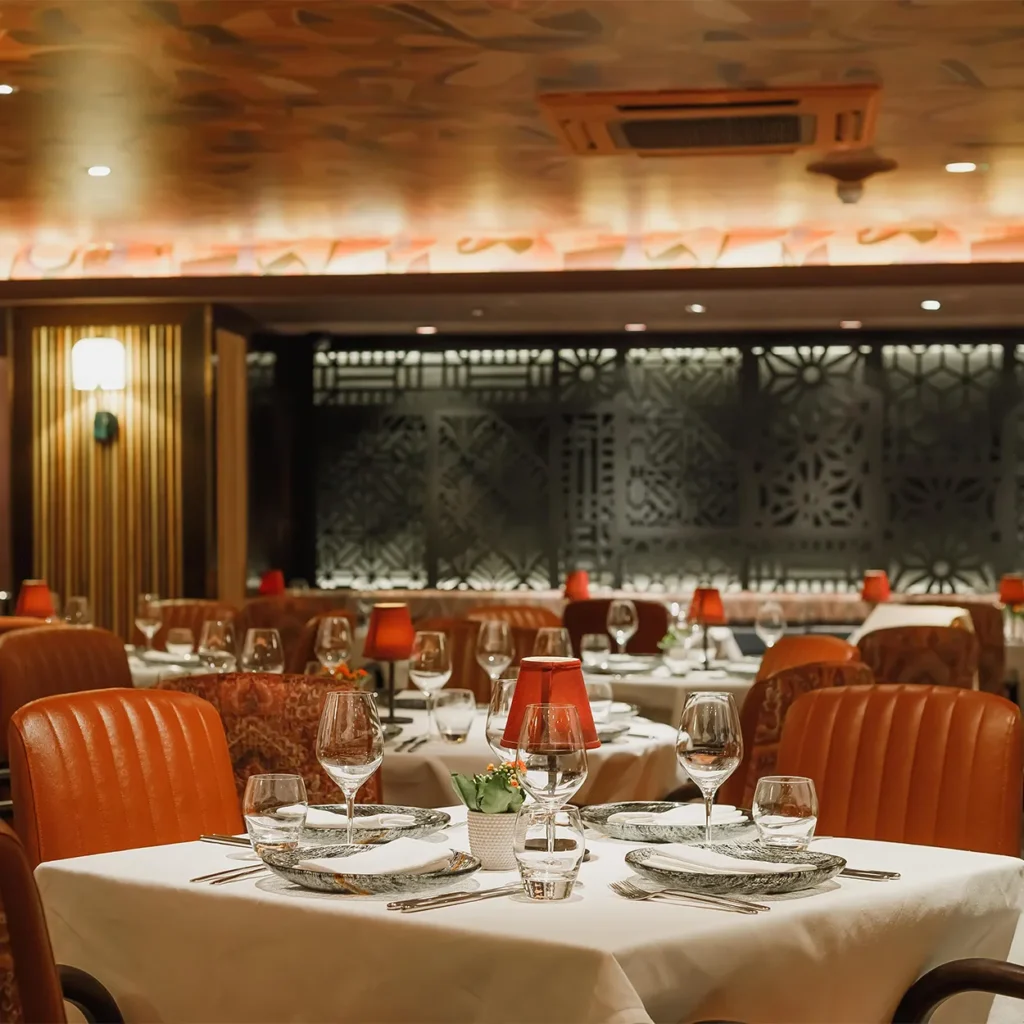
Architecturally, Bocconcino is designed to move guests through different emotional zones. The entrance on Berkeley Street, often framed by seasonal floral installations and tennis-themed façades during Wimbledon, leads directly into a room that nods to upscale trattoria traditions rather than futuristic club design. Warm wood tones, American walnut panelling, patches of exposed brick and soft amber light give the space a calm, grounded feel. Brass detailing and smart table settings anchor it firmly in Mayfair.
At the centre of the ground floor sits a living olive tree. This single piece of planting does a surprising amount of work. It softens the room’s geometry, breaks up sightlines, and serves as a physical reminder of Bocconcino’s Tuscan inspiration. Business guests can hold court over a set lunch menu without feeling as though they are eating in a nightclub, while couples find enough privacy in the layout to relax into the evening without too much theatre intruding on their conversation.
Fun fact: The olive tree that anchors Bocconcino Mayfair’s ground floor is a living specimen, brought in as a focal point to echo the brand’s roots in Forte dei Marmi and to give the room a quietly photogenic centrepiece.
The transition to the livelier parts of the restaurant is marked by a sweeping wrought-iron spiral staircase. In hospitality design terms, this is a classic liminal space, the point at which arrivals turn into participants. Descending the stairwell offers a simultaneous view back to the calm upstairs dining room and forward into the glow and hum of the lower ground. Many guests treat this journey as an entrance of sorts, a brief piece of theatre before joining the crowd.
Downstairs, the environment changes gear. The ceiling opens up to greater heights than many basements manage, reducing any sense of being compressed. To one side, a wood-fired pizza oven glows visibly, with pizzaiolos spinning dough within clear sight of the room. Nearby, a fish counter displays whole seabass, Dover sole and other catch on ice, offering both a visual cue of freshness and an easy way for staff to talk guests through the day’s options. Lighting rigs and a carefully tuned Bose audio system allow the restaurant to move from dinner service to club-like lighting and sound at the flick of a switch. Late in the evening the noise level rises considerably, which will delight some visitors and deter others; this is, unapologetically, a place that enjoys being loud.
Menu Highlights From Wood-Fired Pizza To Paccheri
The culinary direction at Bocconcino is overseen by chef patron Marco Corsica, who has held the post since opening. In an industry where head chefs routinely move on every few years, that length of service is notable. Corsica is Neapolitan by heritage and spent nine years training under Marco Pierre White, which means the kitchen blends southern Italian instincts with classical French technique.
The menu is built around a dual strategy. On one side sits a confident pizza in Mayfair offering, anchored by the wood-fired oven. On the other sits a more traditional line up of antipasti, handmade pasta and grilled fish and meat. The pizza list moves from a clean Margherita through to signature options such as the Pizza Bocconcino, topped with bocconcini mozzarella, and a black truffle version that layers shavings and truffle oil over a blistered crust. These dishes act as volume drivers and as a relatively accessible way into the restaurant for guests who might otherwise find Berkeley Street pricing intimidating.
Pasta is the point at which Corsica’s training shows most clearly. Tagliatelle with black truffle is tossed theatrically at the table in a hollowed Parmesan wheel, delivering both rich flavour and a social media friendly moment that fits neatly with the restaurant’s emphasis on experience. Lobster linguine, often made with Scottish lobster and cherry tomatoes, offers the classic Mayfair comfort combination of shellfish and al dente noodles in a glossy sauce. Agnolotti stuffed with buffalo ricotta and dressed with aglione butter speaks to a more regional Italian sensibility, rewarding those who look beyond the greatest hits.
Secondi dishes make extensive use of a Josper grill. Diners can choose from a “fresh fish marketplace” selection, picking whole seabass or Dover sole to be cooked simply and served with potatoes or tapenade. Meat eaters will find slow-cooked beef short rib with truffled potato, Scottish beef carpaccio and a picanha cut that nods towards South American influences whilst staying within an Italian approach to grilling. Throughout, the underlying philosophy is ingredient-led rather than experimental. Red prawns from Mazara del Vallo and seasonal truffles are used to add intensity and to create easy opportunities for staff to upsell.
For those looking for a structured experience, a partnership with Marchesi Antinori has produced a five-course tasting menu priced at around £75 for food and £140 with pairings. Courses are tuned to work with the house’s Chianti Classico and Super Tuscan wines, including a Gragnano paccheri dish that plays to tomato and ricotta flavours. For wine-led diners, this offers a clear bridge between the restaurant’s party reputation and its more serious enological ambitions.


Wines, Cocktails And High Margin Luxuries
In Mayfair, the most profitable stories are often written in the glass rather than on the plate. Bocconcino’s wine list runs to more than 300 labels, with a core focus on prestigious Italian appellations. The spine of the list is a strong showing of Super Tuscans such as Sassicaia, Ornellaia and Tignanello, bottles whose names resonate with an international crowd used to seeing them on yacht and hotel lists from Dubai to New York. Owner Mikhail Gokhner has spoken about selling wines in the £1,500 to £2,000 bracket daily, a habit that goes a long way towards explaining the restaurant’s reported 20% profit margins in a city where many dining rooms operate at 3% to 10%.
The Italian sections are backed by deep verticals in Barolo and Brunello and by a supporting cast of Champagne and Burgundy to keep traditionalists happy. This is a list built to impress corporate diners, to satisfy collectors entertaining clients and to give celebratory tables the sense that they can, if they wish, push the boat a very long way out.
Downstairs, the Sotto Bar functions almost as a bar within a restaurant, drawing on the current fascination with savoury and culinary-influenced cocktails. Signature pours include Umbrian Forest Whispers, a prosciutto-infused Woodford Reserve bourbon fat-washed with porcini mushrooms for pronounced umami, and Ligurian Coast Echo, which uses focaccia-infused tequila and bergamot. A Tiramisu Martini plays directly into late-night dessert cocktail territory, reimagining the espresso martini with a richer, creamier profile.
Cocktails generally sit around the £14 to £15 mark. In a neighbourhood where some rivals now push mixed drinks north of £22, that pricing feels comparatively restrained and gives Bocconcino a slight edge with guests who want a high-energy bar environment without committing to the most rarefied ticket prices. For the operator, this combination of accessible cocktails, high-volume Prosecco pours at brunch and top-tier Italian wines at dinner creates a powerful wine list and cocktail bar engine underneath the restaurant’s food offer.
What A Day Or Night At Bocconcino Mayfair Feels Like
Bocconcino’s service pattern is designed to flex with the day. Lunch tends to be the calmest window, with a set lunch that attracts local finance professionals, nearby office teams and hotel guests who prefer a more measured atmosphere. The ground-floor room at this time feels almost like a smart business trattoria, with the olive tree and open kitchen providing just enough interest without overwhelming conversations.
Early evening sees a shift towards dates, small groups of friends and families marking occasions. The lighting is lowered, the music steps up slightly and the emphasis is as much on the romantic glow of the room as on the spectacle downstairs. Tableside pasta service and the buzz from the pizza oven create a sense of occasion without tipping into full party mode.
By late evening on Thursdays, Fridays and Saturdays, the lower ground floor transforms. Live musicians and DJs take over, lights pulse in time with house and disco edits, and the space operates in the same broad bracket as other late-night restaurants in Mayfair that lean into bottles, sparklers and dance floor energy. It is at these times that Bocconcino most clearly appeals to the younger, social media-active audience that prizes “Instagrammable” moments and soundtracked nights over quiet gastronomic contemplation.
Weekends bring an additional offer in the form of the Bottomless Brunch Esclusivo. This combines free-flowing Prosecco or pizza with DJs and performers, drawing a crowd for whom Bocconcino is as much a daytime party as a restaurant. Sister venue Osteria Del Mare’s “Italian Riviera Buffet”, with unlimited lobster, supports the group’s positioning as a name associated with abundant and celebratory brunches.
Service, by most accounts, is warm, friendly, and less formal than that of some nearby fine-dining brands. General management has made a point of creating an atmosphere that feels inclusive rather than intimidating. That said, user-generated reviews on platforms such as Tripadvisor and TheFork occasionally flag slower service at peak times, particularly when both floors are at full capacity. This is a common challenge for high-volume, experience-led restaurants and will be a key metric for Bocconcino to manage as demand grows.
Seasonal programming is central to the experience. Themed façades and desserts appear for Wimbledon. New Year’s Eve has previously been styled around a Studio 54 concept, complete with disco balls and performers. At the same time, summer has seen “Carnival of Mayfair” events with dancers and bongo players backed by premium vodka partnerships. For hospitality professionals watching from the sidelines, Bocconcino offers a live case study in how a restaurant can keep itself in the conversation through inventive programming without abandoning its original culinary identity.
Pricing Value And Competition On Berkeley Street
Bocconcino’s pricing strategy is unapologetically high-low. Entry points, such as a Margherita pizza in the £18 to £22 range or a signature cocktail at £14 to £16, are designed to make the experience feel attainable within the context of Mayfair. Guests can, in theory, have a perfectly satisfactory evening of shared pizza, a couple of drinks and dessert without venturing into three-figure territory per head.
At the other end of the spectrum, the menu offers multiple avenues to spend significantly more. Truffle supplements, lobster dishes, whole fish from the marketplace selection and prestige wines allow the restaurant to capture the budgets of guests for whom a £ 200-plus bill is part of the occasion. The £75 tasting menu, aggressively priced relative to those that start well above £100 in many comparable dining rooms, gives curious diners an incentive to test the kitchen’s more ambitious side.
When set against its immediate neighbours, Bocconcino often comes out as the more accessible option. Pizzas are priced below those at Novikov’s Italian room. Lobster pastas and other luxury markers tend to undercut or match rivals. Cocktails are notably cheaper than many of the drinks lists across Piccadilly and Berkeley Street. For visitors using online searches such as best Italian restaurants in Mayfair or an alternative to Novikov in Mayfair, Bocconcino therefore positions itself as the friendlier and better value choice that still delivers the spectacle.
From an operator’s point of view, the restaurant’s reported 20% margin is exceptionally strong for London. The mix of high-margin pizza, controlled food costs, deep wine profitability and a large, high-capacity space that can turn tables multiple times a night underpins that figure. Private dining and corporate hire add another layer of stability, as does the steady stream of guests fed by nearby hotels.
Awards, Reputation And Future Outlook For 2025
Critically and commercially, Bocconcino enters 2025 from a position of strength. Industry recognition includes a British Restaurant Award for Best Luxury Restaurant and LUXlife honours for both its status as an Italian restaurant group and for customer service. On TripAdvisor, it has been included in Travellers’ Choice Best of the Best lists, representing roughly the top 1% of venues worldwide on the platform. Press coverage from outlets such as The London Economic, Time Out and SquareMeal has highlighted everything from its “epic” pizzas and open fire cooking to the versatile, buzzy atmosphere that suits dates, business meetings and group nights out.
The risks are real. Mayfair’s current hotel boom means more on-site competition for room-service budgets and celebratory dinners. The oft-cited “luxury glut” could flatten pricing and chip away at the sense of exclusivity on which parts of the neighbourhood’s image rest. As Bocconcino grows as a group into Soho and Covent Garden, there is also the question of whether the original Mayfair flagship can retain the slightly special, one-off feeling that has helped build its cachet.
Yet the broader trajectory remains positive. Bocconcino has already weathered Brexit, the pandemic and a cost-of-living crisis by adjusting its mix of food, entertainment and pricing without discarding its core Italian identity. Chef Marco Corsica’s long tenure provides continuity and a sense that there is a real person behind the menu rather than a rotating cast of names. The interplay between relatively straightforward dishes and high glamour service slots neatly into what contemporary Mayfair diners appear to want.
For diners deciding where to book, the calculus is straightforward. If you are seeking cutting-edge tasting menus in silence, there are better options elsewhere. If, however, you want a luxury Italian restaurant in Mayfair where wood-fired pizza, truffle pasta, Super Tuscan wines and late night music are all part of the same evening, Bocconcino remains one of the most convincing propositions on Berkeley Street. Choose the ground floor for a quieter business lunch or romantic dinner, descend to the basement for a full-scale party, and, if you are that way inclined, let the wine list steer you into deeper waters. In a quarter of London where restaurants can feel as fleeting as fashion seasons, Bocconcino has become something rarer: a long-running fixture that still feels like an event.