
Few buildings in London have lived as many lives as St Mark’s Church on North Audley Street. Built as a place of worship for Mayfair’s growing population, it became a society wedding venue for the aristocracy, an unofficial chapel for American presidents, a forgotten ruin on Historic England’s at-risk register, and, since 2019, one of London’s most celebrated food halls. The building now known as Mercato Mayfair has a history as rich as anything served inside it.
A Church for a Growing Mayfair (1825–1828)
By the early nineteenth century, Mayfair had transformed from marshland into one of London’s most fashionable districts. The aristocracy and the wealthy had moved in from the country, building grand town houses across the Grosvenor Estate, the vast landholding that the family of the Duke of Westminster had controlled since 1677, when Mary Davies married Sir Thomas Grosvenor and brought 500 acres of West London as her dowry.
But Mayfair was spiritually underserved. The nearest parish churches were overcrowded, and the Church Building Commission, established after the Napoleonic Wars to fund what became known as the “Waterloo churches,” agreed to support a new place of worship on North Audley Street, on a site that had previously been a timber yard.
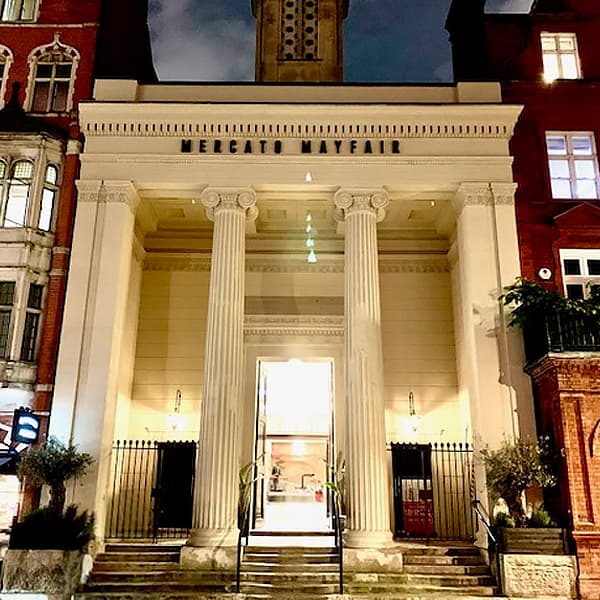
The architect chosen was J.P. Gandy-Deering, a scholar of classical antiquity and one of Britain’s foremost Neoclassical designers. Gandy-Deering faced an unusual constraint: the plot was narrow, the same width as a standard Mayfair townhouse, squeezed between existing buildings. His solution was to concentrate the drama on a single feature, a deep portico with Ionic columns modelled on the Erechtheum in Athens, topped by a square bell tower inspired by the Tower of the Winds. The result was a facade so striking that the architectural critics Britton and Pugin called it “an architectural gem… superior to almost every other analogous building in London.”
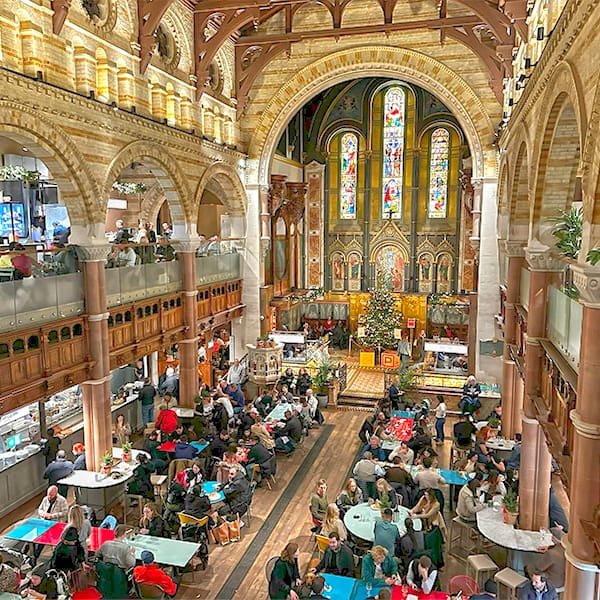
St Mark’s Church was completed in 1828 at a cost of £13,299. Step through the portico today and you pass from a Greek Revival exterior into a very different interior, the result of a substantial remodelling carried out in 1878 by Sir Arthur Blomfield, one of Victorian England’s most prolific church architects. Blomfield introduced a Romanesque open timber roof, rounded Norman arches, and decorative wall treatments that gave the nave the warm, richly textured character it retains to this day.
The American Church: Royalty, Presidents and Benjamin Britten
St Mark’s quickly became one of Mayfair’s most fashionable churches. Its congregation included members of the aristocracy and London’s social elite, and its choir and organ earned a reputation as among the finest in the capital. The church’s three-manual organ, built by J.W. Walker & Sons, attracted distinguished musicians, among them Margaret Cobb, the first woman to play the organ at the BBC Proms at the Royal Albert Hall, and John Williams, the first Master of Music at the Tower of London.
The church also had strong connections to Victorian music and opera. The composer Sir Arthur Sullivan was associated with St Mark’s, and J.W. Elliott, a former organist, composed the well-known hymn tune “Day of Rest” for “O Jesus I Have Promised.” In the late 1940s, the French organist Jeanne Demessieux made pioneering recordings for Decca at St Mark’s, praising the organ’s responsive action and the church’s acoustics.
When the United States Embassy moved to 1 Grosvenor Square in 1938, St Mark’s became the nearest Anglican church to the American diplomatic mission. During the Second World War, with General Eisenhower coordinating Allied operations from Grosvenor Square, the church became informally known as “the American Church.” Both President Dwight D. Eisenhower and First Lady Eleanor Roosevelt attended services there, a connection that gave St Mark’s a unique transatlantic significance.
The church’s social standing reached a peak on 29 September 1949, when it hosted the wedding of George Lascelles, 7th Earl of Harewood (grandson of King George V) to the Austrian pianist Marion Stein. King George VI, Queen Elizabeth, and Queen Mary were among the guests, alongside prominent figures including conductor Sir Thomas Beecham. Benjamin Britten composed and conducted a wedding anthem specially for the occasion. It was one of the most significant society weddings of the post-war era, and it took place not at Westminster Abbey or St Paul’s, but at this intimate church on North Audley Street.
Decline, Abandonment and the Fight to Save St Mark’s
The story of St Mark’s after the war is one familiar to many inner-London churches. As Mayfair’s residential population dwindled, replaced by offices, embassies, and commercial premises, the congregation shrank. By the early 1970s, attendance had fallen so far that the Church of England declared St Mark’s redundant. It was formally deconsecrated in 1974. The last services were held, the original Rushworth and Dreaper organ was relocated to Holy Trinity Brompton, and the doors closed.
The building sat empty for nearly twenty years. Water ingress and dry rot took hold. In 1988, Historic England placed St Mark’s on the Buildings at Risk Register, where it would remain for three decades, one of the most prominent Grade I-listed buildings in London left to deteriorate.
There were various attempts to find the building a new purpose. Planning applications were submitted to convert it into a shopping arcade, a restaurant, an auction house, and a gallery, but none succeeded. From 1994 to 2008, the Commonwealth Christian Fellowship occupied the church under a licence from the Diocese, running services for a congregation of around 120 and providing community outreach including anti-knife crime programmes for teenagers and support for the elderly and homeless.
In 2006, Hammer Holdings applied for planning permission to convert St Mark’s into a wellness centre. A public campaign led by the Save St Mark’s Action Group, headed by Lady Sainsbury, successfully blocked the proposal. The church was subsequently used as a conference and events venue, hosting brands including Nike and events during London Fashion Week, but its long-term future remained uncertain.
Restoration and Rebirth (2014–2019)
The turning point came in 2014, when the Grosvenor Estate acquired the long lease for St Mark’s. Planning permission and listed building consent were granted in 2016 for its conversion into a retail and food market, a use that would bring the building back into daily public life while preserving its architectural heritage.
A meticulous two-year, £5 million restoration followed. The work repaired decades of water damage, restored the stained-glass windows, conserved the decorative stonework and timber roof, and brought the building up to modern standards while respecting every element of its Grade I-listed fabric. The three-manual Walker organ was recommissioned. The Romanesque interior that Blomfield had created in 1878 was revealed again in its full colour and detail.
In November 2019, St Mark’s reopened to the public as Mercato Mayfair, operated by Mercato Metropolitano, the sustainable community market group founded by Italian entrepreneur Andrea Rasca. Today, the building that once echoed with hymns, royal wedding anthems, and Decca recording sessions serves as a three-level food hall, cultural venue, and community space. Its nave is filled with independent food traders, the basement crypt houses a wine cellar and the German Kraft microbrewery, and a rooftop terrace overlooks the Mayfair skyline.
The story of St Mark’s Church is one of the most remarkable architectural journeys in London, from Georgian gem to wartime landmark to at-risk ruin to one of the city’s most celebrated dining destinations. The building has been many things across its 200 years, but it has never stopped being extraordinary.
Visiting St Mark’s Church Today
St Mark’s Church is located at 13A North Audley Street, London W1K 6ZA, in the heart of the Grosvenor Estate in Mayfair. The nearest London Underground stations are Marble Arch (Central line) and Bond Street (Central, Jubilee, and Elizabeth lines), both a five-minute walk. Oxford Street is moments away.
The building is open to the public seven days a week as Mercato Mayfair. Entry is free. Visitors can explore the Greek Revival portico, the Romanesque nave interior, the first-floor gallery, the vaulted basement crypt, and the rooftop terrace. The First World War memorial, a bronze plaque set in gold mosaic commemorating 42 soldiers and airmen, remains in place inside the building.
For full details on food traders, opening hours, and booking, see our Mercato Mayfair listing.
FAQ:
When was St Mark’s Church Mayfair built? St Mark’s Church was built between 1825 and 1828 to the designs of architect J.P. Gandy-Deering in the Greek Revival style.
Why was St Mark’s called the American Church? St Mark’s became known as the American Church during World War II because of its proximity to the US Embassy in Grosvenor Square. President Eisenhower and Eleanor Roosevelt both attended services there.
When did St Mark’s become Mercato Mayfair? St Mark’s reopened as Mercato Mayfair in November 2019, following a two-year, £5 million restoration funded by the Grosvenor Estate.
Is St Mark’s Church Mayfair Grade I listed? Yes. St Mark’s was listed as a Grade I building in 1958, placing it in the same category of national importance as Westminster Abbey and St Paul’s Cathedral.


