
London welcomed 22.7 million visitors in 2025, making it the most visited city in Europe that year, a reminder that the capital remains as magnetic as ever, but also that the old way of “doing London” is starting to feel outdated.
For many travellers, the appeal now lies less in racing between landmarks than in settling into the city’s distinct neighbourhoods, each with its own rhythm, habits and atmosphere. That shift is what makes a staycation-style approach so compelling: instead of treating London as a single destination to conquer, it invites you to experience it as a series of places to inhabit, moving more slowly, staying longer, and discovering the character of the city one district at a time.
London is not one city, but many
London rarely rewards hurry. Distances look manageable on a map, but time disappears quickly between transport changes, queues and over-planned schedules. A three-day stay built around “must-sees” can leave visitors with a strange impression of having seen a lot and understood very little.
A neighbourhood-based stay corrects that. It replaces accumulation with familiarity. The value lies less in adding another museum or viewpoint than in noticing how a district behaves in the morning, where people actually stop for lunch, or how the atmosphere shifts after office hours. That distinction matters in London more than in many other capitals because the city’s identity is not concentrated in one historic centre.
Choosing Mayfair as a base
Mayfair is often reduced to shorthand: luxury, polished storefronts, discreet wealth. All of that is true, but it is also what makes the district useful. Positioned between Hyde Park, Soho, Piccadilly and Oxford Street, it offers centrality without the constant churn of more exposed visitor zones. That balance is hard to overstate over several days.
For a longer stay, Mayfair functions less as a showcase than as a stabiliser. You can walk west into the park, head east toward the West End, or drop into nearby retail and dining corridors without needing to reorganise the day around transport. Travellers comparing hotels in Mayfair, London, for an extended visit are often responding to that practical advantage as much as to the area’s reputation.
There is also a qualitative benefit. Mayfair is compact enough to become legible quickly. After a day or two, the district stops feeling ceremonial and starts feeling navigable, which is exactly what a good city stay should do.
London neighbourhood-by-neighbourhood
The strongest version of a London staycation is not to “cover” the city, but to divide it into a few distinct experiences.
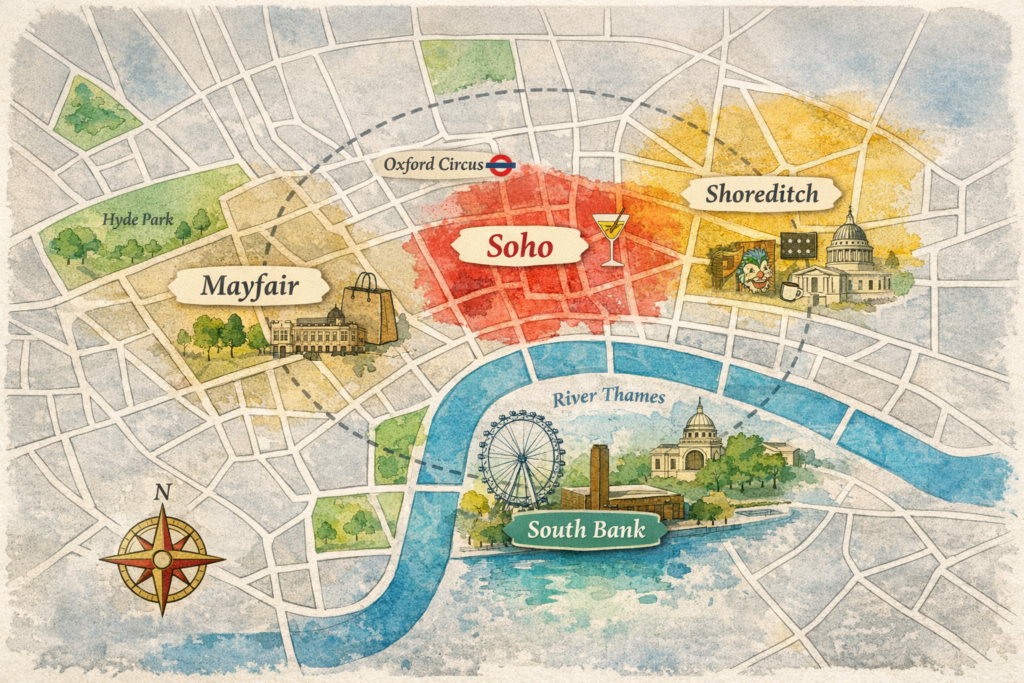
Mayfair: restraint, access, continuity
Start with Mayfair because it clarifies central London. The district is orderly, walkable and comparatively calm in the morning. A slow start might include a walk through Grosvenor Square, followed by a visit to The Royal Academy of Arts on Piccadilly. For something more contemporary, the galleries along Mount Street offer a quieter alternative to larger museums.
Soho: movement and contrast
A short walk away, Soho delivers the opposite rhythm. Streets tighten, footfall rises and the day extends naturally into the evening. Start around Carnaby Street before drifting toward Berwick Street Market for a quick, informal lunch.
As the day shifts, Soho comes into its own. Independent cafés, small theatres and late-opening restaurants make it one of the few areas in central London that feels consistently active beyond working hours. The contrast with Mayfair is useful because it shows how quickly London can change from one district to the next.
South Bank: space and cultural gravity
For visitors who want London to breathe a little, the South Bank remains one of the city’s most legible stretches. The river gives orientation, and the cultural institutions along it impose a different tempo from the retail-heavy West End.
A walk from the London Eye to Tate Modern creates a natural route, punctuated by street performers and open views across the Thames. For a quieter pause, the terraces around the National Theatre offer one of the better places to step back and watch the city move.
Shoreditch: a more contemporary register
Shoreditch is still one of the clearest expressions of newer London: more informal, more visibly shaped by creative industries, and less interested in polish than in turnover and novelty.
Begin around Boxpark Shoreditch before exploring the surrounding streets, where murals and independent shops define the landscape. The nearby Brick Lane remains a focal point, particularly for its mix of vintage stores, cafés and long-standing curry houses.
London’s tourism numbers tell one story: the city continues to attract visitors at enormous scale. The more interesting story is what happens after arrival. Faced with a city this large and this segmented, the smartest decision is rarely to do more. It is to choose a base carefully, reduce unnecessary movement and let the neighborhoods do the work.


