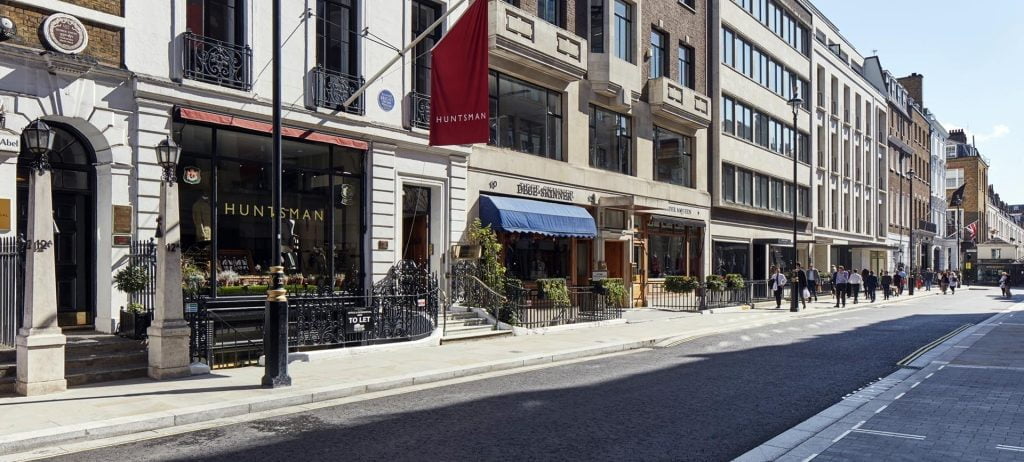
Picture a bright June morning on New Bond Street, where the hum of conversations drifts through open boutique doors and polished windowpanes reflect the sweep of Georgian façades. Halfway along this celebrated mile, passers-by pause to admire the freshly re-imagined Burberry flagship store. A doorman in a midnight coat welcomes clients whose footsteps echo across pale limestone tiles. Inside, the air carries a hint of leather and cedar while soft lighting traces the outline of the vaulted ceiling. Shoppers searching online for “Burberry flagship Mayfair” or “modern British luxury in London” often arrive here within minutes of stepping off the Jubilee line, proof that search intent now lands firmly on this corner of W1. What they find is not just retail; it is a meticulously calibrated experience designed to reposition Burberry at the summit of Mayfair luxury shopping.
A Cornerstone on New Bond Street
Burberry occupies numbers 21 – 23, a prominent corner plot where New Bond Street meets Conduit Street. At 22,000 sq ft across three storeys, the site serves as the brand’s global flagship, a statement reinforced by the sheer breadth of womenswear, menswear and accessories displayed. The location sits inside London’s platinum retail zone, where headline rents stand among Europe’s highest and neighbouring tenants include Dior, Louis Vuitton and Gucci. Here, visibility to an international clientele of high-net-worth visitors is almost guaranteed, turning footfall into a strategic advantage.
The store reopened on 29 June 2023 after a 23-month reconstruction. Engineers removed internal columns, repositioned floor slabs. They replaced the entire façade with a double-height frontage that floods the interior with daylight. Such structural ambition underlines the site’s importance: this is not a flagship in name alone but the architectural foundation of a refreshed corporate identity.
Minimalism with a British Edge
Step beyond the glass vestibule and a striking stillness takes hold. Chalk-white walls, ceiling and floor establish a gallery-like canvas, allowing garments to command full attention. Polished stainless-steel pillars and mirrored plinths introduce flashes of light that bounce across the space. At the same time, curved sofas in biscuit, chocolate and the now-iconic Knight Blue invite visitors to linger. Architect Vincenzo De Cotiis, working alongside Johnson Pinney, intended the environment to frame rather than compete with the product. It is a lesson in restraint: by stripping back visual noise, the store amplifies every stitch of a cashmere scarf and every seam of a Gabardine trench.
Burberry’s famous check appears here not on mannequins but overhead. Linear light panels create a subtle grid that echoes the pattern’s geometry, while tiles in charcoal and off-white punctuate the floor to delineate product zones. The effect is both discreet and unmistakably British, a quiet homage rather than a nostalgic display.
Spaces Designed for People, Not Just Product
The flagship’s layout directs guests on a gentle progression. Accessories greet visitors at ground level, acknowledging the company’s goal to grow leather goods into more than half of total revenue. Womenswear occupies the first floor, menswear the second. Each level features private suites hidden behind sliding panels, furnished with low-slung armchairs, bar trolleys and fresh flowers. These rooms operate as havens for high-value clients who expect time, privacy and a glass of English sparkling wine while deliberating over a made-to-measure trench.
Technology remains present yet largely invisible. Client advisors carry tablets pre-loaded with purchase history and fit notes, enabling instant stock checks or remote transfers without disrupting conversation. Online orders can be collected in store, weaving e-commerce convenience into a tactile visit. For customers overseas, virtual appointments stream live from these suites, ensuring the Mayfair experience reaches Doha or Los Angeles without compromise.
Personal Service as Competitive Advantage
Burberry’s service philosophy draws on Britain’s tradition of quiet courtesy. On arrival, a greeter radios ahead so sales staff know each guest’s language preference and previous purchases. In the trench library, rows of heritage coats hang beneath discreet brass nameplates. Tailoring specialists measure shoulders and hems, then guide clients through fabric weights and lining options. Small leather goods can be monogrammed while guests explore ready-to-wear upstairs. For out-of-town visitors staying at The Beaumont or Claridge’s, the store arranges after-hours appointments complete with chauffeur-driven return.
Such hospitality is not mere flourish; it answers an “experiential arms race” unfolding along the street. When rivals offer couture salons or invitation-only apartments, Burberry counters with its own suites and butler service. Privacy, comfort and expert counsel co-exist, transforming a purchase into a relationship.
Regent Street Versus New Bond Street
London hosts two Burberry flagships separated by a short taxi ride, yet worlds apart in philosophy. The 44,000 sq ft Regent Street store, opened in 2012, pioneered interactive mirrors and runway videos triggered by RFID tags sewn into garments. Screens dominated the atrium, projecting rain showers in sync with musical scores. By contrast, New Bond Street shifts focus from digital spectacle to sensory calm. Here, craftsmanship, materiality and one-to-one dialogue eclipse flashing pixels. The transition mirrors consumer attitudes: today’s luxury shopper often prefers understated refinement over technological novelty, provided service remains seamless.
Retail Strategy and Brand Alignment
The refurbished store stands as the keystone of Burberry Forward, the growth plan introduced by chief executive Jonathan Akeroyd. Where previous leadership championed flashy digital theatrics, the current team centres gravity on full-price sales, deeper storytelling and a product mix weighted toward leather goods. The ground floor of the Burberry flagship Mayfair site reflects this priority: shelves of soft-grained Knight Blue handbags crown mirrored plinths, and silk scarves hang in chromatically ordered runs that catch the eye of passers-by. These displays translate corporate targets into visible proof points. Every mannequin, every light fitting, every private suite tells shareholders and shoppers alike that accessories are now core business rather than seasonal garnish.
Akeroyd’s plan calls for every tier-one store to mirror the New Bond Street concept by the end of fiscal 2025 / 26. Contractors have already completed facelifts in Shenzhen Bay MixC and Dubai Mall, using the London blueprint as a reference. Investors interpret the programme as an advance on intangible equity: a uniform global stage on which Daniel Lee’s collections can shine without distraction. At street level the messaging is simpler. A visitor who browses menswear in Beijing and later lands at Heathrow will recognise the pale terrazzo flooring, the off-white walls and the discreet Equestrian Knight motifs. Consistency breeds familiarity. Familiarity breeds trust.
Strategically, the Mayfair site also hedges against macroeconomic uncertainty. When global tourism softens, affluent London residents remain, and vice versa. By planting its global flagship in a locale that attracts both, Burberry balances revenue streams and protects margins.


Impact on Mayfair Economy and Culture
The reopening in June 2023 pumped an estimated £2 million into local contracting, visual-merchandise design and hospitality in the three months that followed. Westminster City Council counts luxury shopping in Mayfair among its top revenue contributors, and industry analysts credit Burberry’s relaunch for lifting footfall on New Bond Street by six per cent during the 2023 summer quarter compared with 2022. While rivals rely heavily on tour groups, Burberry cultivates local alliances:
- Collaborations with Royal Academy of Arts students for window-display sketches
- Sponsorship of Frieze Masters talks that spill audience traffic into nearby cafés
- Joint gifting experiences with Mayfair boutique hotels such as The Biltmore
Fun Fact: New Bond Street’s first fashion lease dates back to 1730 when the original “Old Bond Street” extension opened, making it one of Europe’s longest-running retail corridors.
The flagship also serves as a magnet for high-value tourism. In September 2023, the Burberry Streets activation drew visitors from 46 countries, according to Transport for London tap-in data at Bond Street station. Restaurateurs on Bruton Lane report weekend reservation spikes that correlate with in-store collection launches. Put simply, when Burberry moves, the neighbourhood eats, drinks and spends.
Competing with Luxury Titans
Four houses dominate New Bond Street. Each presents a distinct philosophy, yet converges on exclusivity and bespoke service.
- Burberry – minimal, gallery-inspired setting. VIP suites feature butler-served cocktails. Trench Bespoke library offers monogrammed gabardine within four weeks.
- Dior – Peter Marino’s neo-classical interiors with gilded mirrors. Three couture salons deliver Demi-Mesure gowns behind sound-dampened doors.
- Louis Vuitton – maison concept curated like a collector’s home. An upstairs “Apartment” hides a library of rare art books and an invitation-only bag atelier.
- Gucci – Grade II-listed shell fitted with rotating contemporary art. The Gucci Salon grants members access to archive pieces not shown elsewhere in Europe.
Where Dior dazzles with ornate finishes and Louis Vuitton celebrates art-house eclecticism, Burberry doubles down on British understatement. The silence of its white surfaces contrasts with Dior’s gilded sconces and Gucci’s tapestry-lined salons. That contrast is deliberate. In a market segment where noise can blur brands together, restraint can speak loudest.
Technology and the Human Touch
The flagship’s most powerful hardware lives in staff tablets rather than on walls. Algorithms parse purchase history to suggest silk colours most likely to complement the client’s skin tone, yet the recommendation arrives verbally from a real person. Smart lighting adjusts Kelvin temperature to mimic natural daylight, allowing shoppers to judge fabric colour accurately. RFID remains in the supply chain but never intrudes on the fitting room mirror. The message is clear: technology serves the conversation, not the other way round.
Online clients feel the benefit as well. Orders placed before 3 pm can be collected in store from 6 pm with alterations completed overnight. Virtual appointments use high-definition cameras that glide on ceiling tracks, offering a near-seamless tour of rails and accessories. Crucially, there is always a human face on screen.
Looking Ahead
Burberry has filed planning applications to redevelop its Horseferry Road head office into a mixed-use campus with design studios, digital production suites and public exhibition space. Insiders suggest the Mayfair flagship will act as a satellite gallery for capsule drops produced there, tightening the feedback loop between studio and shop floor. Sustainability also features prominently. From 2026 all in-store mannequins will be cast from bioplastic, and energy usage is set to fall by 30 per cent after a planned upgrade to the building’s air-handling unit.
Meanwhile, Chancellor proposals to reinstate VAT-free shopping remain under consultation. Should the Treasury reverse the 2021 ruling, analysts predict London could recapture up to £1 billion in lost luxury spend. Burberry, positioned on the very street where global tourists congregate, would be among the earliest beneficiaries.
Conclusion
The transformed store at 21 – 23 New Bond Street is more than polished stone and curated rails. It is the brick-and-mortar thesis of Burberry’s pivot toward modern British luxury. In this space, product speaks louder than pixels and hospitality outshines holograms. By stripping back décor and amplifying personal service, the house broadcasts confidence without ostentation. Competitors may glamourise French opulence or Italian flamboyance; Burberry replies with quiet British conviction.
For residents planning a weekend browse or travellers compiling a 48 hours in London itinerary, a visit offers insight into how heritage can evolve without losing its accent. The lesson extends beyond fashion: clarity of purpose, consistency of voice and respect for audience remain the timeless markers of trust.
As Londoners like to say, “Fine words butter no parsnips.” Burberry, ever practical beneath the polished surface, has chosen to butter the parsnips.