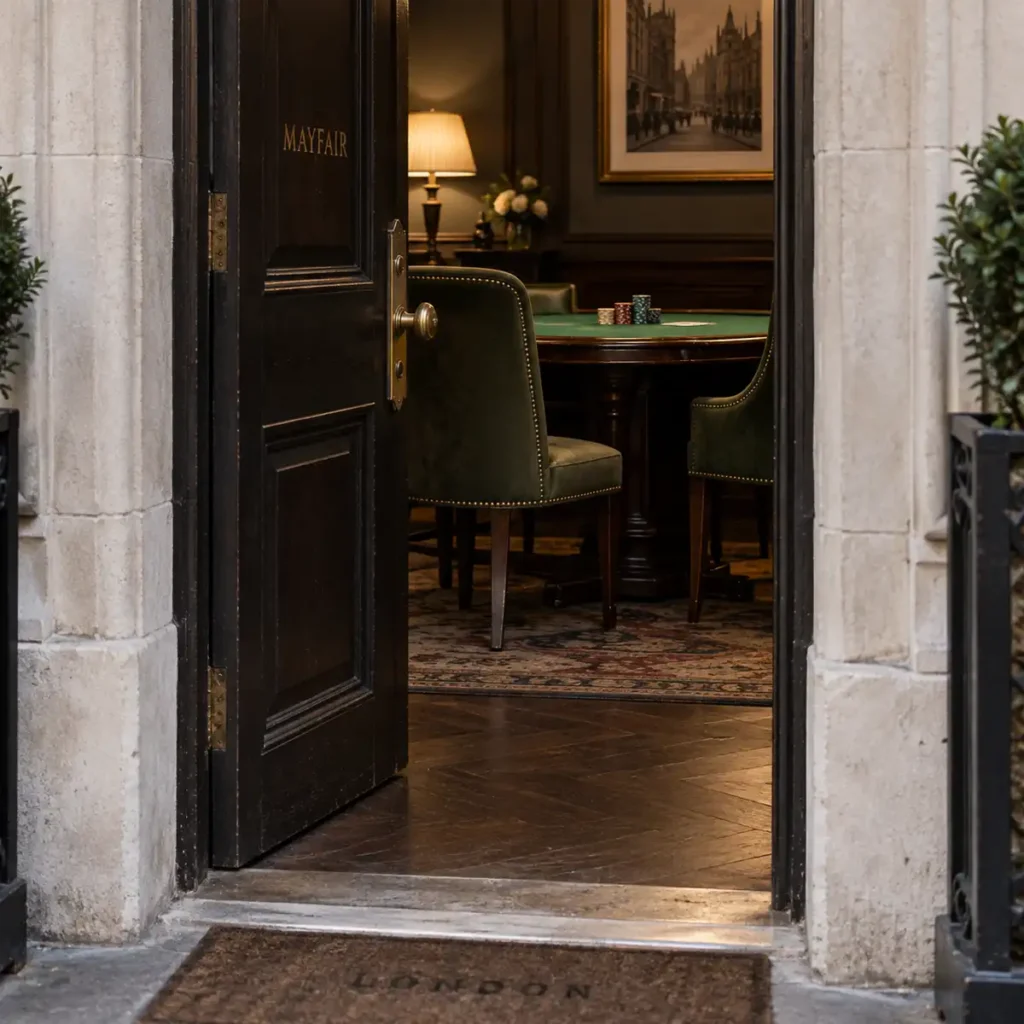
The rooms that shaped how Britain gambles are within a few hundred metres of one another in Mayfair, and most of them are still trading. That is unusual. Almost every other national gaming tradition traces back to a resort, a spa town or a purpose-built strip. This one traces back to a residential square in W1, inside the City of Westminster, where the buildings were never designed for the purpose at all.
British gaming culture did not begin with a casino. It began with a private club that was tolerated rather than licensed, and the habits formed during that period survived the legislation that finally made the activity legal. Almost everything distinctive about British gaming culture today was settled before it was lawful. Our directory lists the surviving houses under casinos in Mayfair.
The starting point is also the most commonly misplaced fact in the story, and it belongs to the next street rather than this one.
The founding story that belongs to St James’s
Crockford’s is routinely described as the origin of Mayfair gaming. It was not in Mayfair. William Crockford opened his clubhouse on 2 January 1828 on St James’s Street, which sits south of Piccadilly and outside the district entirely, and it closed in the 1840s.
The confusion is understandable, because the name later reappeared on Curzon Street as a Mayfair casino. Two separate things share one label, roughly 150 years apart, and the second borrowed the reputation of the first.
The distinction matters for a practical reason. It means Mayfair was not the birthplace of British gaming culture. It was the place that culture moved to when the law changed, and it took that position because of what the district physically had rather than because of any inherited tradition.
What the earlier era did establish was the model. Membership first, stakes second, and a building that gave no external indication of what happened inside it. That template outlasted the law that made it necessary by well over a century.
What the 1960 Act actually created
The Betting and Gaming Act 1960 permitted licensed commercial gaming clubs in Britain for the first time, and licensed betting offices alongside them from May 1961. Within two years the first legal casinos were operating, and Mayfair took a disproportionate share of the early licences for reasons that were entirely practical.
The district had three things that nowhere else combined. Large Georgian townhouses that converted into floors and private rooms without much argument from anybody. The Park Lane hotels, feeding a permanent international clientele who were already resident for other reasons. And an existing private club culture, which meant a gaming room did not have to explain itself to its neighbours.
The 1968 Gaming Act then tightened what had grown quickly, introducing the requirement to have joined a club 24 hours before playing. That rule defined British casino-going until 2007 and is the single reason the Mayfair gaming clubs built membership lists rather than footfall.
The accident of that sequence is what makes British gaming culture unusual. A licence regime arrived first and a membership rule arrived second, so the clubs spent eight years learning to select customers before they were ever asked to attract them. No other major market built its habits in that order.
44 Berkeley Square, and the building that set the pattern
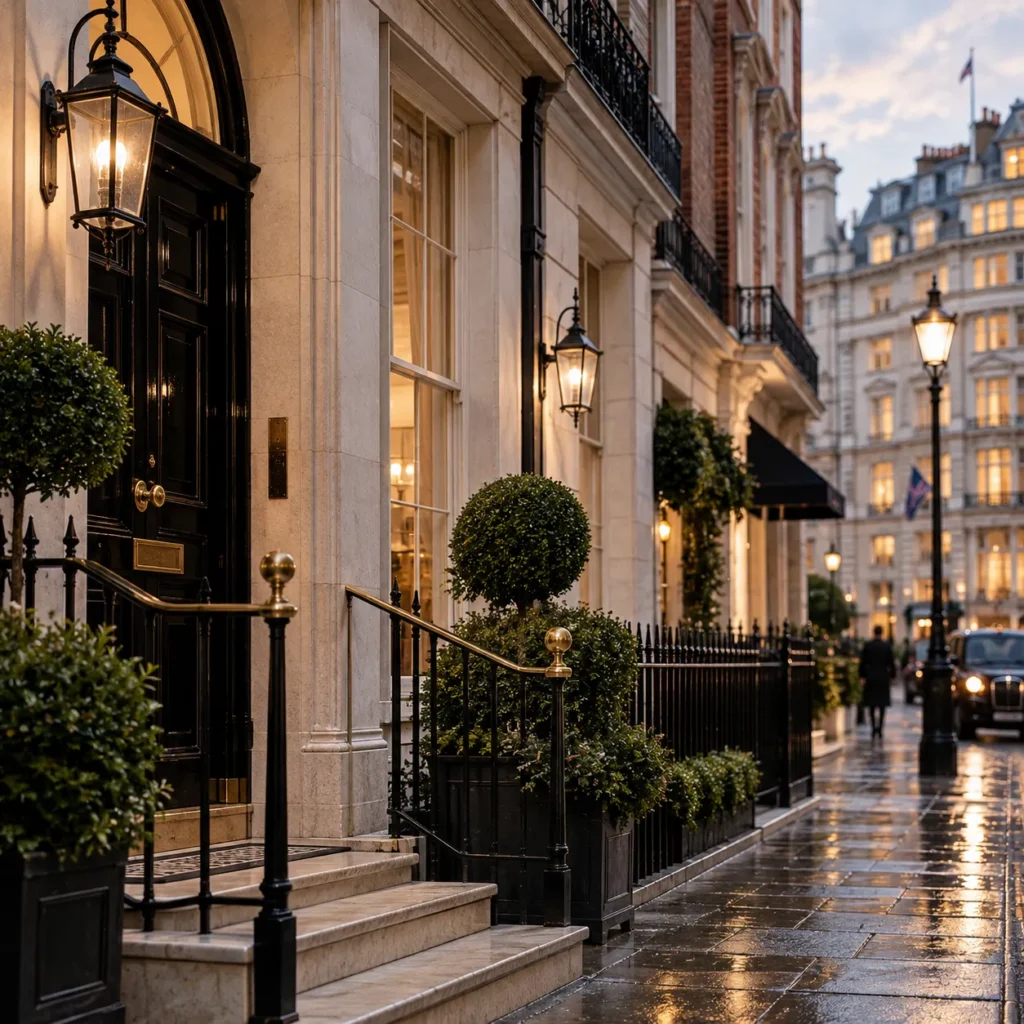
Stand on the north-west side of Berkeley Square, about 7 minutes on foot from Green Park station, and number 44 gives away nothing. A plain Georgian front, a door, no signage of any consequence. Behind it is one of the most elaborate staircases in London.
The Clermont Club opened there in 1962, founded by John Aspinall, whose name later attached to a second house on Curzon Street. Its founding membership was drawn almost entirely from the aristocracy and included several dukes, marquesses and serving cabinet ministers. For roughly a decade that single room was where British gaming culture was written.
Fun fact: 44 Berkeley Square was built between 1742 and 1744 by the architect William Kent for Lady Isabella Finch, who was unmarried and commissioned the house in her own name.
That combination became the operating model for the whole district within a decade. The house remains a house. The gaming happens inside it. Nothing about the frontage tells a passer-by which of the two matters more, and the ambiguity was always the point rather than an accident of planning permission.
What the 2005 Act changed for players
The Gambling Act 2005 took effect in 2007 and removed the 24 hour membership rule, making casual attendance possible for the first time since 1968. It also created the Gambling Commission, and with it a single regulator covering advertising, machine categories and social responsibility across every licensed operator in Great Britain.
Most Mayfair houses kept membership regardless. Once it stopped being a legal obligation it became a commercial filter, which is what the clubs had wanted from it since 1828 and the clearest surviving trace of British gaming culture in its original form. The district’s rooms consequently sit closer in character to its members clubs than to casinos in the American sense.
The less visible change was the supervisory regime that followed. Obligations have tightened steadily since, and they apply to the floors in this district exactly as they apply to remote operators. A statutory levy on licensed operators came into force on 6 April 2025, charged at between 0.1% and 1.1% of revenue, with the highest band falling on remote licensees rather than on the townhouses.
What travelled online and what stayed in the room
The same Act created the framework for remote gambling, and the sector that followed is now the larger business by a wide margin. In the quarter covering October to December 2025, the Gambling Commission recorded £1.49 billion in gross gambling yield from remote casino alone, against £1.2 billion from every land-based sector in Great Britain combined.
Directories covering Online casinos catalogue a market organised around availability rather than admission, where verification happens by document upload instead of at a door. Almost everything the Mayfair houses codified transferred successfully into that format, including dress-equivalent tiering, loyalty structures and private high-limit environments. British gaming culture exported its vocabulary intact.
One thing did not transfer. A room has a memory. Staff notice when a regular is playing differently from usual, and they have both the standing and the instruction to interrupt it.
Reproducing that judgement remotely has proved genuinely difficult, which is why British regulation since 2023 has concentrated so heavily on automated intervention. Financial vulnerability checks at £150 of net spend over 30 days arrived on 28 February 2025, and per-spin stake caps of £5, falling to £2 for players aged 18 to 24, followed on 9 April and 21 May 2025. Each is an attempt to build a doorman out of code.
Support is available free and in confidence through BeGambleAware.
The Mayfair floors are no longer where most British gambling happens and have not been for two decades. What they still hold is the part that was never really about gambling at all. A room, a standard of dress, a set of manners between strangers at a table, and the understanding that you are a guest in a house rather than a user of a service.
That is the part of British gaming culture the rest of the world copied, and it is still local to roughly half a square mile of the West End. If you want to see where British casino history actually happened, the walk from Hamilton Place to Berkeley Street takes about 9 minutes and covers most of it.