
A fashion show is one of the shortest events anyone will ever stage. Twelve minutes, often fewer. Everything before it is preparation and everything after it is coverage, but the show itself is over almost as soon as it begins. That compression is exactly why the room matters. There is no second run, no way to fix a blocked sightline once the first look is out, and no graceful recovery if a lighting cue arrives late.
London has more practice at this than most cities. The capital’s fashion calendar, coordinated by the British Fashion Council, has spent four decades pulling buyers, press and photographers into buildings that were never designed for the purpose: car parks, churches, disused sorting offices, department store basements. Some of that is deliberate, because a collection reads differently against raw concrete than it does against a white cube. But improvisation has a price, and anyone who has stood in a temporary structure at eight in the evening while a generator is coaxed back to life knows what it is.
Here is what the room is actually being asked to do.
Hold the eye
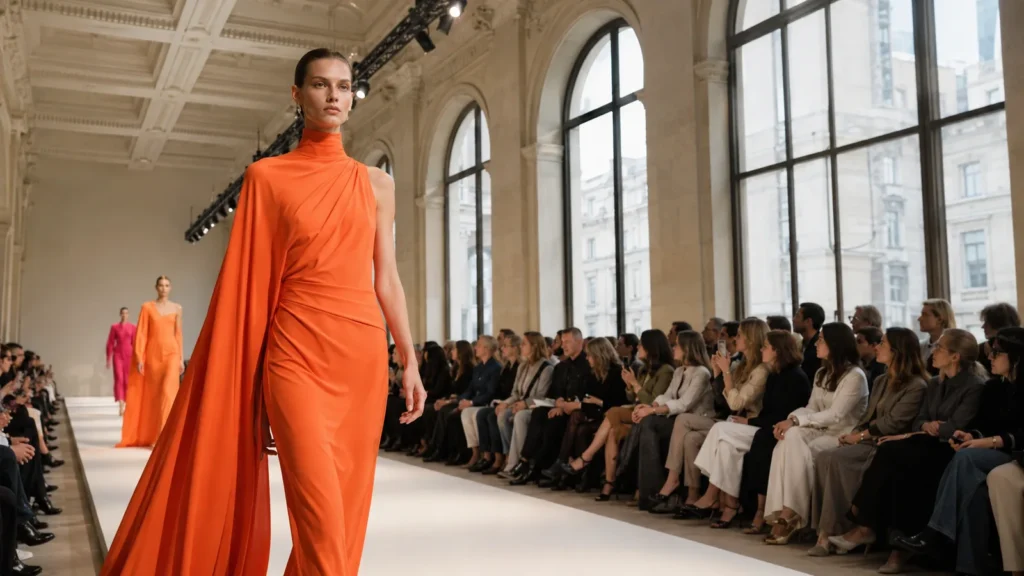
A runway show is a piece of choreography watched from fixed seats, and most of its impact is decided by geometry. Ceiling height gives the lighting somewhere to work from and gives the clothes air above them. Symmetry keeps attention on the walk rather than on the walls. Clean sightlines mean the person in the third row on the far end sees the same show as the buyer in the front. Rooms built for assembly tend to do this without being asked, because they were designed for hundreds of people to look at one point.
Town Hall in King’s Cross is one example of that inheritance. It is a restored civic building whose main hall has thirteen-metre ceilings and the kind of proportions that came as standard when a room was meant to hold a public meeting. It has been a stage before, in ways that had nothing to do with fashion: Claudia Jones launched the first Caribbean Carnival in the same hall in 1959, and The Verve played the building at the height of their powers in 1992. As a London venue used for fashion shows it is unusually well suited, less because it was adapted for the runway and more because it never needed much adapting.
Carry the production
The technical side of a show is where the budget quietly goes, and where an unforgiving room costs the most. Bringing in lighting rigs, sound, power distribution, camera positions and a streaming feed to a space with none of its own means more suppliers, more load-in time and more things that can drift out of sync on the day. Venues with integrated production infrastructure collapse that into a single chain of command. It is worth asking, early, what is already in the building and who operates it, because the answer changes both the schedule and the number of people who need to be right.


Separate three audiences without dividing the show
Press, buyers and guests want different things from the same twelve minutes. Press need positions and a fast route out. Buyers need to see the collection properly and then talk about it somewhere quieter. Guests are there for the occasion. A room that offers only one space forces you to choose which group to serve. Adjoining spaces, a mezzanine level and proper backstage areas let you run fittings, briefings and hosting in parallel while the main hall stays focused on the runway.
Get people there
This is the least glamorous requirement and the one that quietly decides attendance. International press and buyers are usually moving between several shows in a day, and a venue that adds forty minutes at each end of the journey will lose people from the schedule. Central sites with direct rail and Underground access, and in King’s Cross the Eurostar as well, cost less of everyone’s day than they appear to.
The questions worth asking when you walk a room
They are unromantic ones. Where does the truck park and how long is the load-in. What happens to the lighting rig if the show overruns. Where do forty people get changed. Can the front row see past the photographers. How late can the bar run. The answers tell you more than the photographs do, and they are the difference between a show that feels controlled and one that merely looks it from the front row.
The clothes are the point. Everything described here exists so that nobody in the audience thinks about any of it.


