
In 1780 Horace Walpole reported a cast at hazard at the Cocoa Tree in St James’s, “the difference of which”, he wrote, came to a hundred and eighty thousand pounds. The story travelled because the play was public: Georgian London lost its money in clubs whose entire point was that the other members could watch. The Survey of London records that in the 1760s the heavy gambling for which White’s had been famous moved to Almack’s, and the point of both houses was company.
All of that happened a few streets south, across Piccadilly. Mayfair’s own casino culture is much younger, and what it inherited was the audience, not the stakes. Casino gambling only became lawful in Britain with the 1960 Act, there were about a thousand casinos in the country within five years, and the 1968 Act closed most of them down. What survived in the streets off Park Lane was a smaller version of the Georgian room: a jacket at the door in the years when that was the rule, and a table compact enough for everyone at it to see everyone else’s cards. The table is the part that travelled. In live blackjack the cards are still dealt by a person from a shoe, with every other hand in view, only now the audience is watching through a camera.
Face Up, by Law

The London game was built to be watched, and not by accident. The regulations that governed casino blackjack in Britain from 1995 required the cards to be “dealt face upwards so as to be disclosed immediately to all the players”. A game with nothing hidden can be followed from the next seat, from across the room or through a lens, and the studios that took it online didn’t have to alter it. All they had to do was point a camera at a table that was already set out so people could watch it.
The habits went with it. A player who never touched a card in a Mayfair club still doesn’t, and the dealer’s hands are the only ones on the shoe. Seven strangers sit down and can all see each other’s cards, which is what the regulation wanted. The etiquette mostly stayed in the club, starting with the fact that there is nobody to tip.
Plasterwork and Opening Hours
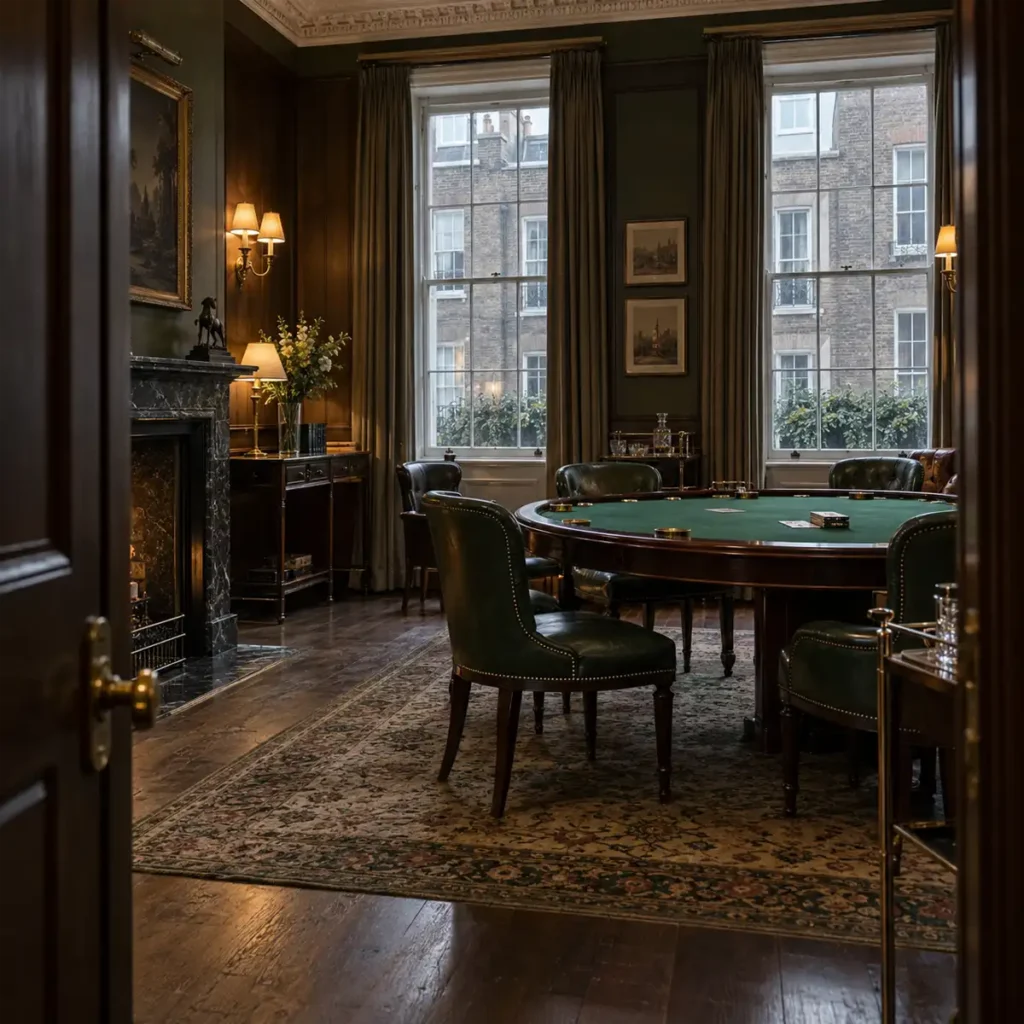
What the camera doesn’t get is everything Mayfair built around the cards. The Georgian clubs were dining and society houses where hazard was one pursuit among several, and the post-war casinos copied the model, a dining room attached to the tables, in rooms with plasterwork older than the licence. You can see the same thinking in the hotel dining rooms a few doors along, where Café 22, relaunched this September inside The Twenty Two hotel, brings a martini trolley to your table instead of putting the drinks on a menu.
What the screen removed was the closing time. A club shuts at four in the morning; a phone doesn’t, and the discipline that a closing time used to supply now has to come from the player, which is a real loss. Stakes changed too. A club’s minimum was a number chosen to keep the room selected, and online there is no room to keep selected. Some people think that’s the point. Others think it’s the problem.
Still Being Watched
The face-up rule hasn’t changed, and other people can still see your hand; they are watching a stream now rather than sitting in the next chair. The plasterwork, the jacket and the dinner are all still in Mayfair, where they always were. Walpole’s cast at the Cocoa Tree was news because a roomful of people saw it happen.


