
For the past five years, Oxford Street has faced a tough question about the role of flagship stores in an era when most customers start shopping on their phones. The M&S Marble Arch redevelopment offers one of the clearest answers in the UK. It is more than just a retail upgrade; it signals how central London plans to trade, work, and move forward in the late 2020s.
The stakes are not theoretical. In a statement released after the 5 December 2024 approval, Marks & Spencer said West End footfall was still 30% below pre-pandemic levels as of May, with vacancy on Oxford Street at about 15%, roughly 3 times the 2019 level. Those figures explain why a single corner site at Marble Arch became a proxy fight over the future of Oxford Street regeneration, and why the planning outcome was treated as a signal to investors watching London’s retail core.
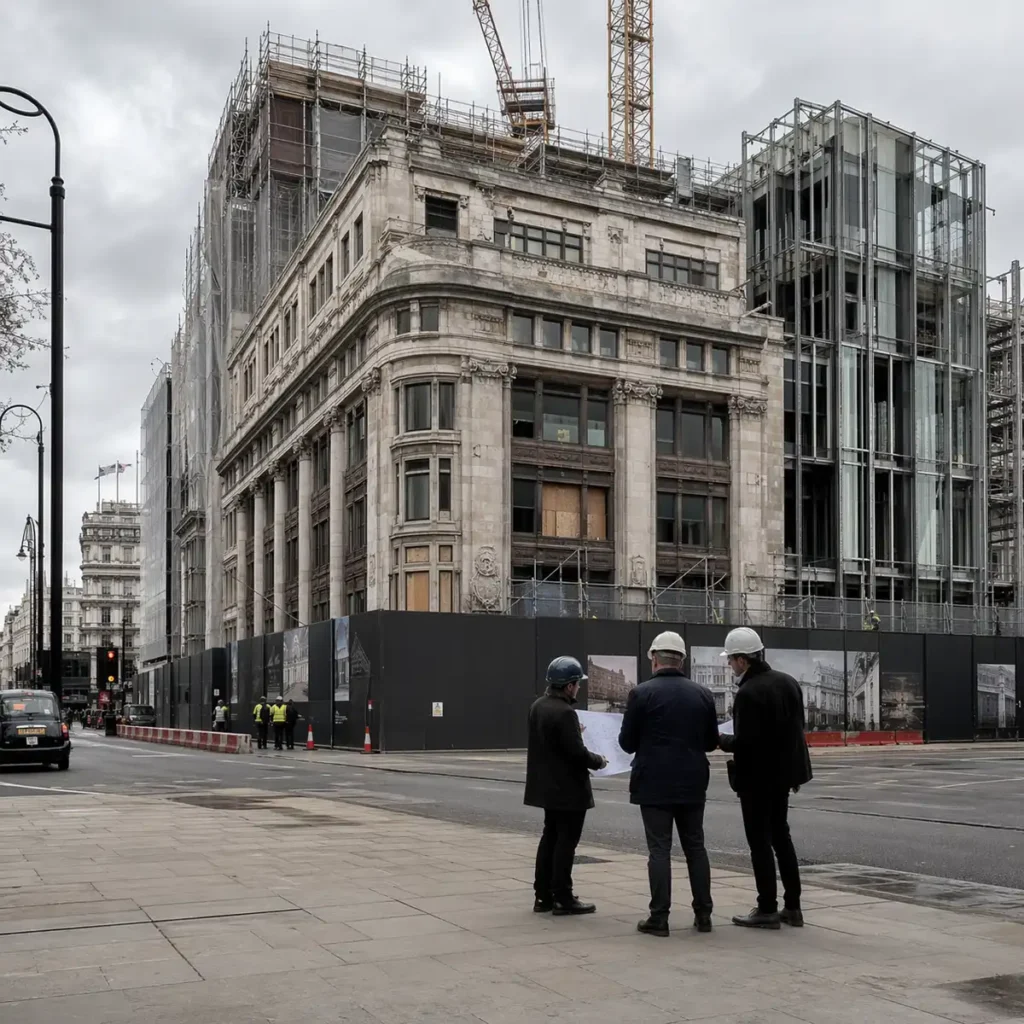
Rebuilding raises tougher questions than a simple renovation. Every tonne of carbon from demolition and every new square metre must be weighed against the option to reuse, even if reuse is difficult in practice. This tension shaped the debates, the court case, and the final political decision.
As London Bets On Flagship Retail To Drive A 2025 Revival
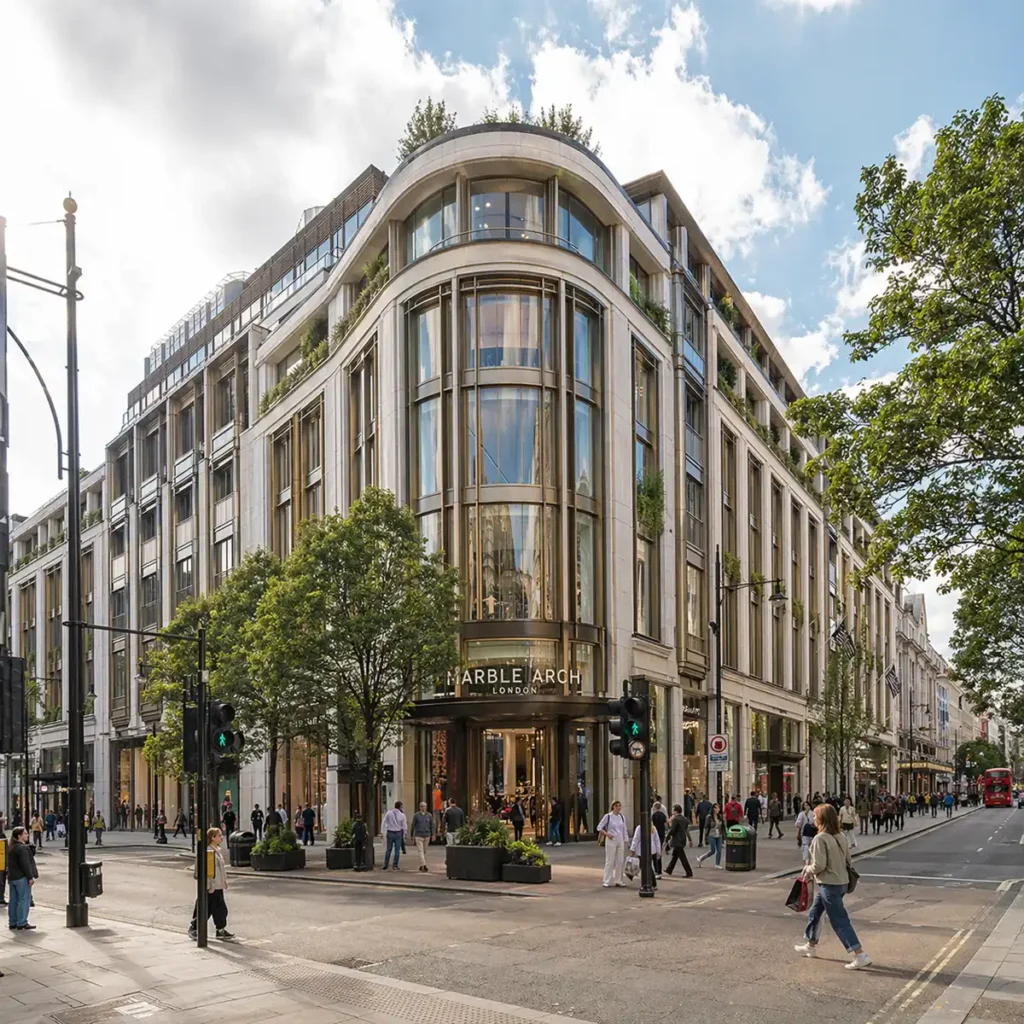
This redevelopment is important because the Marble Arch end of Oxford Street is seen as a test case for a wider recovery plan for 2025 and beyond. The project aims to keep a major retailer open long-term, while adding offices and public spaces to keep the area lively after shopping hours.
Angela Rayner’s approval letter in December 2024 focused on public benefits, such as the risk of losing a major tenant and the wider impact on the area’s vitality. When a flagship store closes, it affects more than just one retailer. It can hurt nearby cafés, reduce foot traffic at transport hubs, and change how safe and lively the area feels, which influences whether other brands choose to open there.
For Marks & Spencer, the message was equally direct. In its own post-approval statement, the business positioned the scheme as a retail-led regeneration project designed to support 2,000 jobs, while also arguing that operational performance and store productivity depend on a modern building rather than a stitched-together legacy structure.
One sentence sums up the strategic calculation. A flagship is no longer mainly about selling more stock on the day. A flagship is about proving the brand still belongs in the physical city, and about making that presence pay for itself across multiple income streams.
Why Rebuilding The Orchard House Site Became The Chosen Option
Supporters of rebuilding say the current complex does not meet modern retail needs or building standards. The store is made up of several buildings joined over time, which means customers face dead ends, awkward changes in floor levels, and departments that do not connect well for shopping.
That operational story sits alongside a sustainability problem. The simplest way to cut operational emissions is to stop bleeding heat through a poor envelope and to electrify services so the building can decarbonise as the grid decarbonises. In its December 2024 statement, the retailer said the new building would use less than a quarter of the energy of the existing structure and would halve water consumption, while targeting 95% recovery, recycling, or reuse of existing building materials.
Opponents can still raise valid concerns, even if they agree with the project’s long-term goals. Much of a building’s climate impact comes from the carbon released during demolition and from new materials. This is why the Marble Arch debate became part of a bigger national discussion about how the UK should build in a time of strict carbon limits.
A key point for readers is that both sides can be right at the same time. Demolition can be a short-term climate cost. Poor operational performance can be a long-term climate cost. The policy system is increasingly being asked to decide which cost carries more weight on a specific site.
How The M&S Marble Arch Redevelopment Reset The Retrofit Debate
The planning saga became a national case study because it was not a simple yes or no. Westminster approved the scheme, it was called in, it was refused, it was challenged, and it came back again with the facts scrutinised in public and then tested in court.
Michael Gove refused the plan in July 2023 after a call-in and inquiry, with the refusal leaning on heritage and carbon concerns. Campaign groups, including SAVE Britain’s Heritage, pushed for a retrofit-first approach and argued that the embodied carbon cost of rebuilding was too high to justify when reuse might be possible.
The High Court then changed the centre of gravity. In March 2024, the judgment quashed the refusal and found, in effect, that national policy wording encourages reuse but does not create a strong presumption that reuse must win regardless of viability. That matters because it tells developers and councils what the legal floor actually is, and it tells campaigners where the next policy fight needs to be if they want stricter reuse outcomes.
A quote from the judgment captures the commercial risk that sat underneath the legal reasoning. The inspector’s conclusion, cited in court, warned that refusal would probably lead to closure and “substantial harm to the vitality and viability of the area”. That is the type of sentence that changes how decision-makers weigh a project, because it ties carbon arguments to the survival of a major economic anchor.
In 2025, this is the policy direction of travel. Reuse must be considered seriously, and the evidence must be robust. Rebuild is not automatically disqualified if alternatives are judged unviable, undeliverable, or incapable of meeting the adopted plan objectives on that site.
What Whole Life Carbon Means When Cities Count Emissions Properly
A whole life carbon assessment adds up emissions from construction, maintenance, and operation over a building’s lifetime, instead of looking only at demolition or yearly emissions. For Marble Arch, the idea was that higher initial emissions could be offset by much lower emissions during use over many years.
Campaigners and commentators commonly cited an embodied carbon figure of about 40,000 tonnes of CO2 for demolition and rebuild, which is the kind of number that lands with the public because it feels immediate and irreversible. The counter-argument was that clinging to a structurally awkward, energy-hungry building can lock in operational emissions for generations, and that the relevant metric is the net position over the building’s life.
M&S’s own post-approval statement said a whole-life carbon assessment undertaken by Arup supported the conclusion that the new build offered significant sustainability advantages over refurbishment. The same statement said the scheme’s carbon payback would be within 11 years, with a 120-year design life, and it added that the company had committed to reducing whole life carbon by a further 10% compared with earlier assumptions.
The design team at Pilbrow & Partners also describes the project as all-electric, intended to cut operational energy dramatically, and shaped around long-life adaptability rather than short-cycle retail fit-outs. That matters because adaptability is one of the few practical ways to stop today’s “new build” becoming tomorrow’s stranded asset.
There is still genuine debate here, and it should not be glossed over. Whole life carbon modelling depends on assumptions about occupancy, grid decarbonisation, refurb cycles, and how long a building actually stays in use. The Marble Arch lesson is that UK planning is starting to demand that those assumptions be surfaced and argued, rather than implied.
Fun fact: City Hall said a traffic-free Oxford Street event in September 2025 lifted footfall by 45% and increased takings by 56% versus the previous Sunday.
How Mixed Use Offices And Public Realm Design Change The Business Case
Mixed-use is not a decorative add-on. Mixed-use is now the financial engine that makes many prime high street redevelopments viable, because it spreads risk across retail trading, workspace leases, and potentially leisure or food and drink.
On this scheme, the public benefits are partly about the street-level experience. The design proposal includes new routes through the site and wider improvements to the immediate public realm, intended to make the corner feel less congested and more navigable. The inspector’s report for the 2024 decision also assessed impacts on nearby assets, including Selfridges, concluding that the proposal could sit within the area’s heritage context without causing unacceptable harm.
Above the shop floors, the scheme is built around workspace and terraces, not as a gesture but as a demand response. In its own project description, Pilbrow & Partners describes 64,700 square metres of mixed-use development and capacity for 1,400 additional employees, which is the type of number that turns a retail site into a weekday economy as well as a weekend one.
This shift also changes what “retail productivity” means. A smaller retail footprint can outperform a larger one if it is supported by consistent daily footfall from workers upstairs, fast fulfilment logistics, and a shop design that behaves like an omnichannel hub rather than a traditional department store.
It is also where quality becomes measurable. The government decision document records sustainability certification targets, including BREEAM Outstanding for the office element and BREEAM Excellent for the retail element, which are not cosmetic badges. Those targets force engineering and fabric decisions that influence operating costs and tenant demand in a market that now prices energy risk more explicitly than it did in 2019.
Why Premium Visitors From Mayfair Matter To Oxford Street Recovery
The tourist economy around Marble Arch is not simply about selfie traffic. It is about high-spend patterns, perceived safety, and whether the West End feels like a coherent destination that competes with global retail corridors.
Mayfair sits close enough to shape the visitor mix, particularly for travellers choosing hotels and planning shopping on foot between districts. When the public realm is cramped, polluted, or confusing, affluent visitors have alternatives, including Bond Street, Knightsbridge, and online. When the street is quieter and legible, the same visitors are more likely to extend their time in the area and spend across categories, from fashion to food.
This is where regeneration language can become too abstract, so consider the practical scenario. A traveller staying in Mayfair can cross to Oxford Street for a single purpose, then leave quickly. Or that traveller can treat the area as a wider loop, where retail, food, and cultural stops blend into a half-day experience. The second outcome depends on walkability, wayfinding, and the presence of anchors that signal quality rather than churn.
New West End Company and City Hall have repeatedly framed Oxford Street’s future around a stronger experience mix, rather than an arms race of floor space. The Marble Arch scheme fits that logic because it aims to be open, modern, and durable, rather than simply bigger.
How The Oxford Street Development Corporation Could Speed Up Change
Oxford Street’s next phase is as much about governance as architecture. In 2025, City Hall’s argument has been that the street’s problems are too strategic and too cross-boundary for slow, fragmented decision-making to fix.
The Oxford Street Development Corporation is due to start on 1 January 2026, after legislation and consultation work through 2025. The consultation material published by City Hall said 6,642 responses were received, with about 2 in 3 supporting the principle of pedestrianisation, which provides a political mandate even while details still attract debate.
The business case is being made in economic terms, not only aesthetic ones. A City Hall report on Oxford Street’s transformation cited an estimated increase in gross value added of nearly £82 million per year and support for 781 additional jobs, which is the type of quantified benefit that planning systems are built to weigh against disruption and cost.
The September 2025 traffic-free event gave the argument a fresh data point. City Hall reported not only a 45% footfall lift but also stronger trading outcomes on the day, which suggests the public realm can change behaviour quickly when people feel comfortable lingering.
There are also risks. Pedestrianisation can displace traffic into neighbouring streets, and security design has to be integrated rather than patched on later. The balancing act for London in 2025 and 2026 will be delivering a cleaner, calmer street without shifting problems one block north or south, and without turning public space into a hostile landscape of barriers.
Conclusion
The M&S Marble Arch redevelopment is a single building, but it functions as a referendum on what Oxford Street is for in the mid-2020s. The project’s logic is that retail survives by becoming more productive, more digital in fulfilment, and more intertwined with offices, leisure, and the public realm. The politics and the court ruling show that retrofit is no longer optional to consider, but rebuild can still win when alternatives are judged undeliverable, and the public benefits are substantial.
If City Hall’s 2025 momentum on pedestrianisation translates into delivery, the flagship will open into a street that behaves less like a traffic corridor and more like a destination. The safest prediction is not that Oxford Street returns to an old peak. The safer prediction is that it evolves into a new model, like a river redirected into a stronger channel, still flowing, but with different banks guiding its force.


