
How to evaluate winding systems, certified protection, interior design and installation before entrusting a serious collection to a single cabinet.
A serious watch collection is not merely an inventory of expensive objects. It is an evolving mix of movements, wearing habits, complications and personal history. Protecting it therefore calls for more than a heavy steel box. A well-specified watch safe should combine credible burglary resistance with an interior designed for the ways collectors actually live with their watches.
For an initial view of the available formats, specialist European watch safes demonstrate the range of winding capacities, storage layouts and certified constructions now offered. The useful starting point, however, is not the catalogue. It is the collection itself: what must remain running, what should rest, where the safe will stand and which security standard an insurer will recognize.
What Is a Watch Safe?
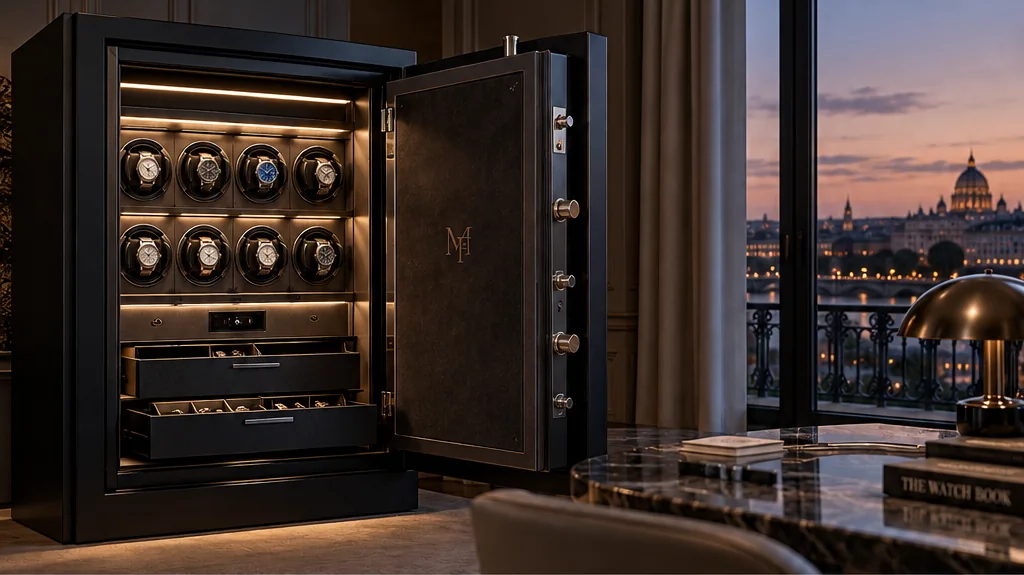
A watch safe is a secure storage unit configured specifically for wristwatches and their accessories. Beyond the lockable enclosure, it may include programmable automatic watch winders, separate static compartments, soft-lined jewelry drawers, lighting and serviceable electrical components. A luxury watch safe is successful when mechanical care, organization and physical protection work together without compromising the certified security envelope.
Watch Safe vs. Conventional Home Safe
A conventional home safe is primarily a secure cavity for documents, cash or general valuables. Its shelves are rarely optimized for polished cases, delicate bracelets or multiple watches that need separate support. A collector-specific interior instead manages clearance around watch heads, prevents metal-on-metal contact and permits watches to be retrieved without disturbing adjacent pieces.
The distinction is not automatic proof of better security. An ordinary certified safe may offer stronger burglary resistance than a beautifully finished but uncertified watch cabinet. Compare the actual tested construction first, then evaluate the quality of the watch-specific fittings. Design and certification answer different questions.
What Integrated Watch Winders Actually Do
An automatic watch uses wrist motion to replenish energy through its rotor. When the watch is off the wrist, a winder rotates it at programmed intervals to maintain sufficient power reserve. This can be useful for frequently rotated watches and calendar complications that are inconvenient to reset. It does not improve a movement merely by keeping it in motion, nor does it replace routine servicing.
The best integrated systems provide independent settings rather than turning an entire bank of watches at one shared speed. They also provide stable holders suited to differing wrist sizes and bracelets, protected cable routing and access for replacing an individual motor. Static storage remains essential for manual-wind, quartz and seldom-worn pieces.
How Many Winders Does a Collector Really Need?
Winder count should reflect the number of automatic watches a collector intends to keep running, not the total number owned. Consider someone with eighteen watches: six regular-rotation automatics, four rarely worn mechanical pieces, three manual-wind watches and five others. That collector may be better served by six to ten winding positions and generous static storage than by eighteen powered slots.
Complicated pieces may change the calculation. A frequently worn annual or perpetual calendar can justify a dedicated position because setting it is more involved. Conversely, an automatic chronograph worn twice a year can comfortably remain at rest, subject to its manufacturer’s guidance. Reserve a modest amount of expansion capacity, but do not pay for a wall of motors simply to fill empty holes.
TPD and Rotation Direction: The Settings That Matter
Turns Per Day (TPD)
TPD means the number of programmed revolutions delivered in a day. There is no universal setting for every automatic calibre. Some movements require comparatively few rotations to maintain reserve; others need more. Consult the movement manufacturer or a reliable movement-specific winding database before assigning a setting. Excessive TPD is usually unnecessary, while too little may allow the watch to stop.
Clockwise, Counterclockwise and Bidirectional Winding
The winding direction must also suit the calibre. Some mechanisms wind effectively in one direction, others in both. A bidirectional program alternates rotation, but the way manufacturers count total turns in that mode is not always identical. WOLF’s published winding guidance, for example, explains its own programming conventions. Confirm both the movement requirement and the winder’s counting method rather than relying on a brand-wide assumption.
The Modern Configuration-Led Watch Safe
Modern watch winder safes can combine individualized winding positions with resting trays and jewelry storage in a single engineered installation. Mercier & Fils, a French specialist working internationally, illustrates this approach through its Régent range. Its TimeDrive™ M1 individually configurable module concept and Coil Winding technology speak to a useful principle: each automatic watch should receive the program its own movement requires.
Other names contribute distinct perspectives. WOLF is well known for programmable winders and watch-care accessories, while Buben & Zörweg has developed elaborate combinations of winding technology, presentation and secure cabinetry. Across these approaches, the most meaningful comparison is the same: verifiable security, control of each module, maintainability and interior space that remains practical after the initial installation.
Watch Safe Certification: Start With Evidence
A substantial door, imposing weight or fingerprint scanner does not establish a recognized burglary rating. Request the exact standard, grade or classification, issuing certification body and certificate or listing that applies to the proposed model. Certification normally concerns a defined construction and approved hardware, so an optional lock, custom aperture or structural alteration must not be assumed to retain the original rating.
For European safes, EN 1143-1 is a principal burglary-resistance standard; independent certification may be documented by ECB·S. Separate standards apply to high-security locks, and separate testing is needed for fire protection. A safe described as “fire resistant” should be evaluated against the precise fire classification and contents it covers, not the wording of a brochure.
EN 1143-1 vs. UL 687: Similar Purpose, Different Methods
Both EN 1143-1 and UL 687 are serious frameworks for evaluating burglary-resistant safes through prescribed physical attack tests. They address broadly comparable buyer concerns, but their classifications are not interchangeable.
EN 1143-1 grades are based on a granular Resistance Unit (RU) methodology that accounts for the attack tools and resistance demonstrated under defined test conditions. UL 687 instead uses designations such as TL-15, TL-30 and TL-30X6, with specified attack durations and test coverage. The “X6” designation indicates testing of the safe’s six sides rather than merely its door and front face under the relevant classes.
A higher EN 1143-1 grade can involve broader or more demanding provisions than a basic UL TL designation, yet this does not make every European grade stronger than every UL class. There is no responsible universal conversion such as “EN Grade III equals TL-15.” A US buyer should have the precise European certificate reviewed by the insurer or security adviser rather than substituting an invented equivalence.
What Grades I, III and V Mean for a Collector
Grade I: An Established Certified Starting Point
Within the EN 1143-1 system, Grade I marks a recognized level of tested burglary resistance. It may be relevant to a smaller private collection when accepted by the insurer and supported by sound installation. It should not be treated as a universal statement about insurance coverage or as a substitute for assessing the home’s wider security.
Grade III: Stronger Requirements for Higher-Risk Holdings
Grade III imposes more demanding resistance requirements than Grade I within the same European framework. It may be considered where the insured value, location or threat assessment calls for additional protection. The practical consequence may include changes to door structure, overall mass, installation arrangements and price.
Grade V: A Higher-Security Project, Not a Styling Upgrade
Grade V represents a further step in the EN 1143-1 hierarchy and should be approached as a security and logistics project. Selected Régent configurations are offered on ECB·S-certified EN 1143-1 constructions, with options extending up to Grade V depending on model and project. Buyers should distinguish these from non-certified configurations within the same broader collection and insist on documentation for the specific unit supplied.
Construction, Locks and the Certified Envelope
Burglary resistance comes from an engineered system, not simply steel thickness. Doors, boltwork, relockers, hinges, barriers and fill materials interact under attack. Some designs use specialized internal composites; STRATIUM™, described for selected Mercier & Fils constructions, is one example of a proprietary material approach. Such terminology may explain construction choices, but independent testing remains the more useful basis for comparison.
The access system deserves equal scrutiny. A biometric reader such as BioLock® can make daily opening convenient on compatible configurations, yet fingerprint access alone says nothing about burglary certification. European certified safes may use locks assessed under EN 1300, with permitted models and classes defined by the certified configuration. Ask what happens during a power failure, how authorized users are managed and which recovery method has been approved.
Interior Materials, Static Storage and Jewelry Drawers
Soft linings matter because the most common everyday risk to a watch is not a break-in but avoidable handling damage. Look for removable cushions that fit small and large wrists, smooth drawer runners, ample depth for high-profile cases and partitions that prevent bracelets, clasps and precious-metal jewelry from rubbing against one another. Well-designed static trays should hold pieces securely without compressing leather straps or stretching bracelets.
Jewelry drawers require their own logic: ring rolls, necklace channels and separated sections rather than an undivided velvet box. Allow storage for travel cases, straps, watch tools, service records and warranty cards, while keeping backup documents and any access credentials elsewhere. Lighting should aid selection without producing excessive heat.
Noise, Vibration and Long-Term Reliability
Quiet operation matters if the safe is in a dressing room, bedroom or study. A manufacturer’s decibel figure is meaningful only with the measurement distance, number of motors running and test conditions attached. Ask whether motors can be individually disabled, how vibration is isolated and whether a failed module can be serviced without removing the entire safe. The cumulative sound of multiple mechanisms may differ from a single-unit demonstration.
Installation: Weight, Anchoring and Floor Load
Watch safe installation begins before the delivery truck arrives. Confirm the gross weight of the exact specification, external dimensions, center of mass, doorway and elevator clearances, staircase geometry and the full path to the intended location. A safe weighing several hundred kilograms can create concentrated loading that needs assessment by a qualified structural professional, especially above ground level or on timber floors.
Anchoring is not optional merely because the safe is heavy. Follow the manufacturer’s prescribed fixing method, the conditions of its certification and the insurer’s requirements. The fixing substrate matters: a suitable structural slab is not equivalent to finish flooring or an unsupported screed. A discreet installation also needs door-swing clearance, accessible maintenance panels and a planned power supply that does not compromise the protected enclosure.
Buying a European Watch Safe in the United States
An American collector considering a European-built safe should verify more than transatlantic freight. Ask whether the exact electrical configuration supports US mains power, who handles customs classification and import charges, how the cabinet will be moved from the port or airport to the final room and which local specialists can install, anchor and service it.
Insurance recognition is especially important. A European EN 1143-1 certificate may be informative and credible, but a US underwriter can have policy-specific requirements involving UL classifications, alarms or documentation. Obtain written acceptance before ordering. Mercier & Fils undertakes private projects for collectors in the United States, illustrating how international supply increasingly involves specification, logistics and aftercare rather than shipping alone.
What Determines the Cost of a Luxury Watch Safe?
Price is driven by the security construction and rating, cabinet size and mass, number and sophistication of winding modules, customized interior joinery, finishes, electronic access controls and specialist delivery. The least expensive quoted configuration can become materially more costly when anchoring, lifting equipment, building works, insurance requirements or onsite servicing are included. A fair comparison uses like-for-like certification and installation scopes, not headline capacity alone.
Future-Proofing the Collection
Collectors rarely know which watches they will own ten years from now. Leave some flexible static space, specify adjustable holders and confirm whether individual winders and control electronics can be replaced. The ideal layout accommodates changes in case diameter and movement type without forcing a complete redesign. It should also remain usable if the power supply is interrupted: a safe is first a protective enclosure and only then an electrical appliance.
A Watch Safe Buyer’s Checklist
- Inventory each watch by movement type and identify those that truly need active winding.
- Confirm individual TPD and winding-direction controls, including how bidirectional turns are counted.
- Request the exact safe certification, approved lock details and written insurer acceptance.
- Specify separate static watch positions, jewelry drawers, bracelet clearance and future capacity.
- Verify transport route, total installed weight, floor loading, anchoring and electrical access.
- Clarify delivery responsibilities, installation, warranty coverage and local repair arrangements.
Frequently Asked Questions
Does every automatic watch need a winder?
No. An automatic watch can safely stop while stored, subject to the maker’s instructions. Winders are primarily about convenience, especially for watches worn in rotation and complicated calendars that take time to reset.
Is a biometric watch safe automatically secure?
No. Biometrics describe a method of access, not a burglary-resistance classification. Evaluate the certified construction and approved lock system of the exact configuration.
Can a certified watch safe also protect against fire?
Possibly, but burglary testing and fire testing are different. Ask for separate fire-resistance documentation specifying the test standard, classification, duration and protected contents.
Does a heavier safe always offer better protection?
No. Weight can make removal more difficult, but its distribution and the tested construction matter. Anchoring, location and independently verified resistance are stronger decision criteria than mass alone.
Can EN 1143-1 Grade III be treated as UL TL-15?
No. The European and US systems use different test methodologies and labels. A direct numerical conversion is not valid; consult the certificate and the insurer’s written requirements.
How much extra capacity should a collector plan for?
Allow a realistic margin for future acquisitions, particularly in static storage. Powered positions should still be based on the automatics you intend to keep running rather than every potential purchase.
The Collector’s Long View
A well-chosen watch safe is a discreet part of collecting infrastructure. Its value lies in making responsible security compatible with the pleasure of wearing and caring for fine watches. Specify protection through evidence, winding through the needs of individual calibres, and installation through the realities of the building. The result should remain appropriate long after the present arrangement of watches has changed.