Many people start their first serious jewellery purchase in London with something small, like quietly trying on a ring or holding a bracelet up to the light. Questions about finish and wear often reveal more than just the budget. Victoria Beckham jewellery stands out because it works on two levels. The official label offers design-focused pieces seen as accessible “little luxuries,” made from Italian-crafted gold-tone brass with a simple, sculptural style. Meanwhile, Beckham’s own collection of rare gemstone rings adds a sense of high-end aspiration to the brand’s story.
For buyers looking at central London options, this split is helpful, not confusing. The brand’s flagship is at 36 Dover Street in Mayfair, and its style fits right in with the city’s other jewellery spots, like Hatton Garden and West End showrooms. To understand how Victoria Beckham’s influence shapes both the brand’s offers and its reputation in the London jewellery scene, this report explains how Beckham’s personal collection and the label’s jewellery style support each other, what you can expect from the brand, and what this means for anyone considering engagement rings or statement pieces in London.
A designer who treats jewellery as part of the architecture
The source describes Victoria Beckham as a Creative Director who pays close attention to detail and has a refined, controlled style. She doesn’t see jewellery as just decoration, but as a way to highlight shape, hardware, and proportion. The label’s approach has shifted from the “tight and controlling” style of the early 2000s to a modern “off-kilter elegance” that values comfort, function, and small, intentional imperfections.
This change is important because it redefines the purpose of jewellery. In Beckham’s view, each piece should do at least one of three things: create a sharp line, add a personal touch, or bring in a practical element that makes luxury feel more real. The source connects this idea to daily life, mentioning perfume bottle charms inspired by her makeup routine and clothing designed to “make a woman’s life easier,” influenced by her experience as a working mother of four.
The label jewellery offer and its signature motifs
The official jewellery collection is positioned as accessible luxury, made at a London studio and crafted in Italy. The pieces focus on sculptural shapes and delicate chains. Most items are made from gold-tone brass, with finishes that can be brushed for a vintage look or polished for extra shine. Instead of diamonds, crystals are used to add sparkle at a more affordable price.
Within that offer, the source identifies a set of recognisable motifs and ranges.
The Dorian edit and B-frame motif
This is described as the main signature design. The motif is a geometric, minimalist “B” frame that appears on signet rings, hoop earrings, bracelets, and hair clips. The design is inspired by the clean lines of a vintage men’s briefcase given to Victoria by David Beckham, matching the brand’s taste for masculine-style hardware. Some Dorian pieces are marked “1 of 1,” showing exclusivity, though the source does not explain this in detail.
Zodiac pendants
There is a collection of shiny gold-tone necklaces with astrological symbols like Aries, Pisces, Libra, Sagittarius, Scorpio, and Capricorn. The main appeal is personal storytelling, which the source often connects to Beckham’s own jewellery choices.
Fragrance necklace series
Fillable perfume bottle pendants tied to Victoria Beckham Beauty, with named fragrance references including San Ysidro Drive, Suite 302 and Portofino ’97. The source describes gold, brushed brass, and coloured enamel wraps designed to mirror the fragrance flacons.
Chunky and structural forms
The source mentions heavier pieces, such as chunky cuffs, necklaces, and rings, meant to stand out when worn with simple, tailored outfits.
Camellia line and whistle necklace
The Camellia range is described as a softer, floral motif spanning rings, bracelets and pin brooches. The whistle necklace is described as a gold-tone enamel pendant featuring the VB logo, originally inspired by lifeguard whistles for a surf-themed collection.
For readers interested in fine jewellery, it’s important to clearly distinguish categories. The key takeaway: Victoria Beckham’s label jewellery is valued for shape, finish, and brand style, while her personal collection centres on rare gemstones and precious metals. This clarity helps buyers align their expectations with what each category offers.
Runway styling and strategic jewellery partnerships
The source shows Beckham using runway jewellery to demonstrate taste and positioning. In SS21, a virtual presentation is linked to Tiffany & Co., with Beckham photographed in yellow gold T1 rings and bracelets around the show. The effect is not subtle: an established jewellery language underscores that the clothes belong in a high-luxury context.
Other examples in the source focus more on the brand’s story. For AW25, perfume bottle charms were used as necklaces and bag decorations, nodding to her makeup routine. For SS26, jewellery became more structural, with small wires creating ruffles around necklines, inspired by wings from Romeo and Juliet.
The early New York shows from 2008 to 2012 were intentionally minimal in accessories, often using Beckham’s own engagement rings as the main jewellery statement. This early simplicity is important because it connects the brand’s jewellery identity to her personal ring story from the beginning.
The engagement ring Rolodex and the meaning of stone choice
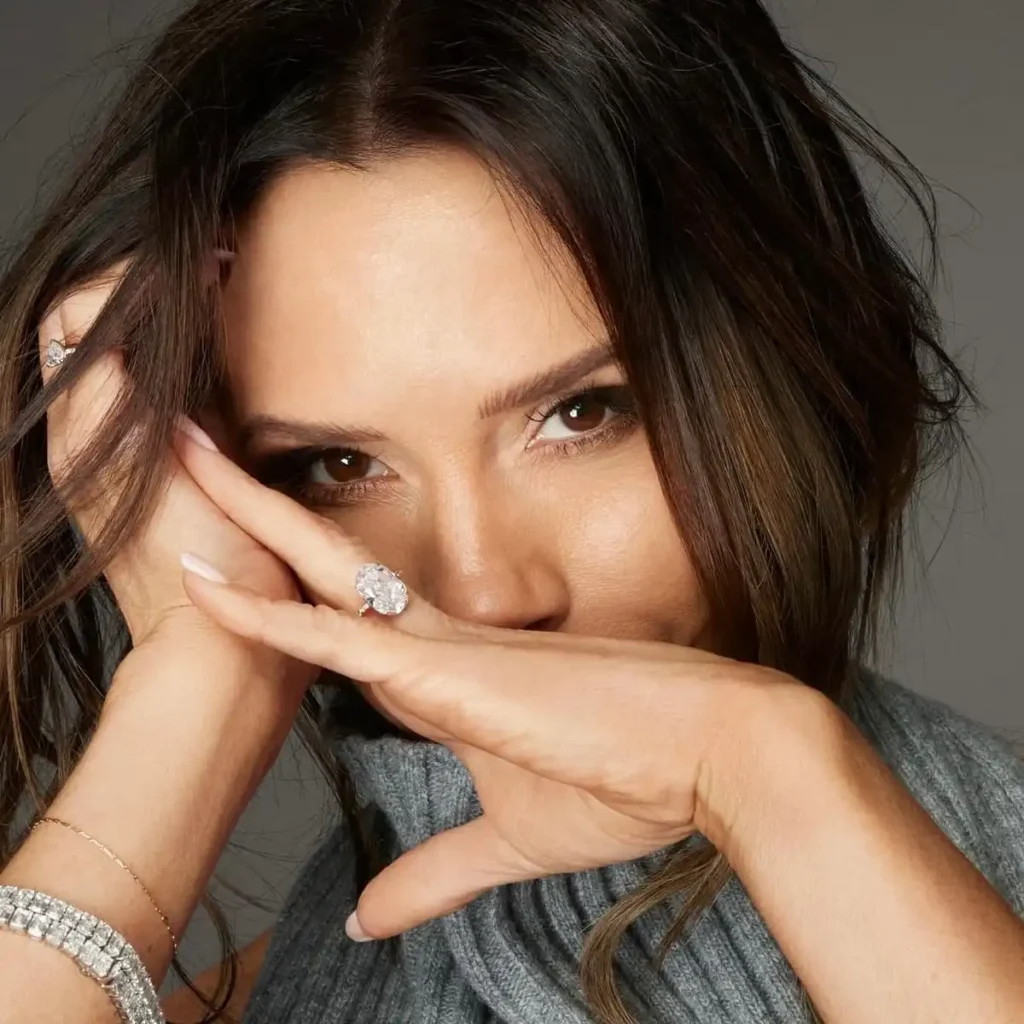
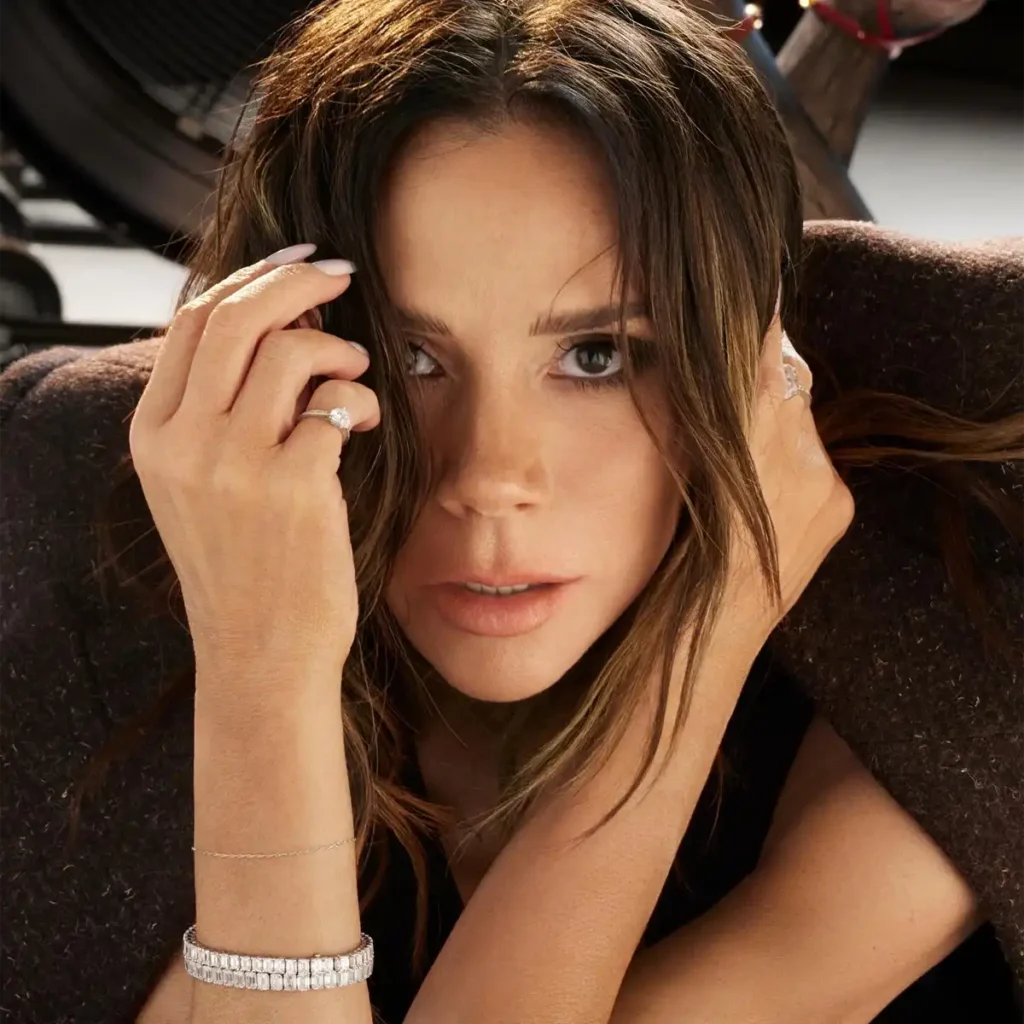
Beckham’s personal jewellery is the aspiration engine. The source describes a rotation of more than 15 engagement-style rings gifted over the Beckhams’ personal jewellery collection, which drives the brand’s sense of aspiration. The source says she has received over 15 engagement-style rings during her marriage, valued by gemmologists at about £32 million to £35 million. These rings are seen as a changing wardrobe that marks different periods, not just a single heirloom.999 wedding at Luttrellstown Castle with a gold and diamond tiara by Slim Barrett. By 2003, the source lists a 6 ct emerald-cut diamond with side baguettes, followed in 2004 by a 7 ct pink champagne diamond ring credited to Jacob & Co. In 2005, a 17 ct pear-cut diamond on a pavé band appears, and in 2007, the tone shifts with a 25 ct cushion-cut emerald in a spiral setting.
Other entries in the source include a 15 ct emerald-cut white diamond ring by Chopard in 2008, a 15 ct “pigeon blood” ruby ring set in a diamond halo in 2009 (linked to the family’s move to Los Angeles), and the description of additions slowing around 2010 amid reports of label debt, with a blue sapphire ring added. Later milestones include the 2014 opening of the Dover Street flagship in Mayfair and a 2015 appearance at the CFDA Awards in a Jacob & Co. moonstone-and-diamond ring. A square-cut yellow diamond ring on a gold pavé band is noted in 2018, adding to the source’s emphasis on rare diamond colour within the wider rotation.
For engagement ring shoppers, the practical insight is that stone choice clearly signals a new chapter. The source explicitly treats the move into coloured stones as a visible change in 2007. That is useful for anyone who arrives expecting only diamond options and then realises that coloured gemstones can carry meaning, individuality and immediate visual impact. It is also a reminder that settings matter: halos, pavé shoulders, and baguette sides are not only aesthetic choices but also affect daily wear and maintenance expectations.
Fun fact: Victoria Beckham’s 1999 Slim Barrett wedding tiara was valued at £18,000 to £25,000 for a 2013 Bonhams auction, but bidding only reached £14,000 and it didn’t sell.
Materials, metals and what sits behind the look
The source describes a split materials palette that mirrors the split between label products and personal items. The source explains that the materials used reflect the difference between the label’s products and Beckham’s personal collection. mimic high-watt sparkle at accessible prices. Enamel appears most clearly in the fragrance charms, with shades described as Eggshell White, San Ysidro Yellow and Portofino Blue.
Personal collection
Platinum and 18 ct yellow gold are the usual settings, often with pavé diamond shoulders. The source points out a preference for bright green emeralds, “pigeon blood” rubies, and deep blue sapphires, as well as rare-coloured diamonds such as pink champagne and yellow. There is also mention of a moonstone and diamond ring from Jacob & Co. in 2015.
The main takeaway for buyers: clarify what value matters most. Choosing Beckham’s label means prioritising shape, proportion, and brand image. If superior gemstone quality matters, consult a specialist jeweller for advice on stone, setting, and documentation. Use these criteria to guide your search.
Price reality for the label and how resale behaves
The source positions label jewellery as an entry point and provides typical RRPs:
- £80 to £150 for small items, with examples including a Dorian signet ring at £100 and a fine chain at £90
- £150 to £400 for core pieces, including a Dorian bracelet at £340 and a perfume charm at £280
- £400 to £850+ for statement items, including a chunky cuff bracelet at £820 and a zodiac necklace at £580
It also references resale. Perfume bottle necklaces are listed on The RealReal at £150- £250, with an estimated retail price of £280- £330. Dorian pieces are described as available on Vestiaire Collective, ranging from £100 for earrings to £250 for necklaces.
This resale pattern matches the materials used: these are fashion jewellery pieces from a luxury brand, and their resale value reflects that category.
How to use this story in your own London ring search
If you’re shopping at the Dover Street flagship, treat the jewellery as design-focused accessories. Ask about the materials, how the finish will hold up, and how to care for the pieces. If a piece has stones, ask what they are and how they are set for strength. In London or commissioning a bespoke engagement ring with a specialist, the Beckham jewellery narrative is most valuable as a reference set. Use it to name what you respond to: emerald cuts with baguette sides, halos around a coloured centre stone, pavé shoulders, or a spiral setting that feels more unconventional. Then ask the questions that protect you as a buyer:
- What documentation accompanies the stone or stones, and what is the setting designed to protect
- What aftercare support is available, and what costs may arise later
- What timeline is realistic for resizing and finishing before a proposal? Give yourself enough time. Buying a ring in a hurry often leads to needing quick resizing, rushed repairs, or making compromises. Whether you’re looking in Hatton Garden or booking appointments in Mayfair, make sure you have time for decisions, adjustments, and the fact that custom orders take different amounts of time depending on the workshop.
Who does this universe suit?
Based on the source, the label jewellery will appeal most to shoppers who want an architectural look, a coherent hardware language and recognisable motifs without entering high jewellery price territory. It is also well-suited to gifting through zodiac symbols and fragrance-linked charms.
Beckham’s personal jewellery choices, by contrast, offer a map of what statement rings can do when stone choice is treated as identity. If you are considering coloured stones for an engagement ring, the timeline reinforces that an emerald, ruby or sapphire can be a deliberate signature rather than a compromise.
The simplest conclusion is also the most practical. Victoria Beckham’s jewellery identity is built on a deliberate dual system: accessible design for purchase and rare-stone imagery for aspiration. Knowing which side you are engaging with is the clearest route to confidence, whether your next stop is Mayfair or Hatton Garden.