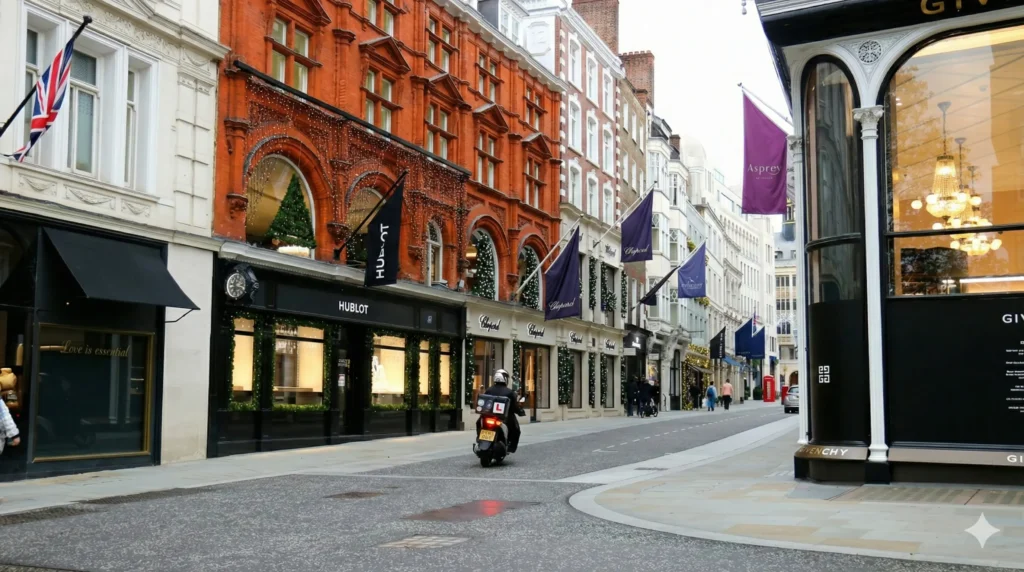
Mayfair has long been synonymous with discretion, refinement, and a particular understanding of lasting worth. From its Georgian origins to its modern role as a global centre of affluence, the district has consistently favoured materials that signal permanence rather than novelty. Silver occupies a distinctive place within this landscape, appearing not only in domestic and ceremonial contexts, but also in the broader language of tangible wealth, from crafted household objects to minted forms such as silver coins, which have historically represented material integrity, trust, and continuity across generations.
Silver and the Historical Identity of Mayfair
Mayfair’s emergence as one of London’s most prestigious districts coincided with a period in which material culture played a central role in expressing social position. As aristocratic estates gave way to refined townhouses, the objects within those homes were expected to reflect discernment as much as wealth. Silver became integral to this environment, valued for its balance of visual restraint and inherent material worth.
Unlike decorative materials chosen purely for display, silver carried an immediately recognisable substance. Its use within Mayfair homes aligned with a broader preference for assets that could endure changing tastes and political climates. As a result, silver was not merely an accessory to the district’s development, but a material woven into its identity, reflecting a long-standing association with stability, tradition, and measured affluence.
British Silver Hallmarks and the Language of Authenticity
The credibility of silver within British society has long been reinforced by the hallmarking system, a framework designed to protect quality, purity, and provenance. These marks, applied by authorised assay offices, offered reassurance that silver objects met recognised standards, allowing them to circulate confidently within affluent districts such as Mayfair. Over time, hallmarking transformed silver from a purely decorative material into one defined by accountability and trust.
For households and collectors alike, hallmarks provided a shared reference point, enabling silver to be assessed with clarity rather than conjecture. This transparency suited a district that has historically placed value on discretion and verification over display. In Mayfair, where reputation has always mattered, the regulated nature of silver reinforced its status as a material associated with authenticity, continuity, and enduring worth.
Silver in Mayfair Homes: Objects of Use and Meaning
Within Mayfair residences, silver has traditionally occupied a role that is both practical and symbolic. Items such as tableware, serving pieces, and decorative objects were selected not simply for visual appeal, but for their ability to withstand regular use while retaining dignity and character. Silver’s durability allowed it to function as part of daily life rather than being confined to display, reinforcing its association with permanence.
These objects often carried significance beyond their immediate function. Passed down through generations, silver became intertwined with family histories and domestic rituals. Its capacity to develop a patina rather than deteriorate mirrored Mayfair’s preference for materials that age with integrity, ensuring silver remained a constant presence within the district’s evolving interiors.
The Role of Silver in Mayfair’s Social and Cultural Life
Silver has long played a subtle but important role in Mayfair’s social customs, particularly in settings where hospitality and ceremony intersect. Formal dining, private gatherings, and institutional events have historically relied on silver to convey order, respect, and occasion. Its presence at the table or within a room signals continuity with established traditions rather than a desire for spectacle.
Beyond function, silver contributes to the theatre of social interaction. The weight of a silver object, its reflective surface, and its tactile qualities reinforce a sense of deliberateness in moments that are designed to be remembered. In Mayfair, where social rituals often unfold behind closed doors, silver has quietly supported a culture that values formality, discretion, and an appreciation for materials that carry recognised meaning.
From Heritage to Modern Relevance: Silver in Contemporary Mayfair
While Mayfair’s relationship with silver is rooted in history, the material has continued to adapt to contemporary contexts without losing its cultural relevance. Modern interiors, galleries, and private spaces within the district still incorporate silver, often in more restrained or minimalist forms that reflect current design sensibilities. This evolution demonstrates silver’s ability to remain relevant without abandoning its traditional associations.
In today’s Mayfair, silver is valued as much for what it represents as for how it appears. Its physical presence offers reassurance in an era increasingly shaped by abstraction and digitisation. By retaining a clear connection to material authenticity, silver continues to resonate with those who value substance, longevity, and the quiet confidence of assets grounded in reality.
Why Physical Silver Continues to Carry Weight in Mayfair
Physical silver retains significance in Mayfair because it embodies qualities that extend beyond appearance or trend. Its tangible nature, inherent scarcity, and long-standing acceptance as a material of value have ensured its continued relevance among those who favour assets that can be directly understood and assessed. In a district defined by discretion, this physicality offers reassurance without the need for overt display.
Unlike abstract representations of wealth, silver exists independently of systems or intermediaries. Its weight, purity, and recognisable form provide clarity in how value is perceived and preserved. For many within Mayfair, this clarity aligns with a broader preference for materials that have proven their resilience over time, reinforcing silver’s role as a quiet constant within the district’s cultural and economic landscape.
Conclusion: Silver’s Enduring Place in Mayfair
Silver’s presence in Mayfair is not defined by fashion or fleeting relevance, but by continuity. Woven through the district’s architectural, social, and cultural fabric, it has long represented a preference for materials that balance refinement with substance. From historic households to contemporary settings, silver has retained its meaning precisely because it resists obsolescence. In a place where value is understood quietly, and longevity is respected, silver remains an enduring expression of heritage, authenticity, and lasting worth.