
There is a particular moment in a Smith and Green consultation, usually around the second cup of tea, when a buyer leans forward slightly and asks the question they were not sure they were allowed to ask. What about a sapphire instead? The hesitation is unnecessary. Sapphire engagement rings are not a compromise on the diamond; they are a separate decision with their own merits, and once you understand what a sapphire actually is, the conversation shifts from concession to genuine preference. This article is for the buyer who is curious, who wants the colour, and who needs to know whether sapphire can carry the structural and emotional weight of an engagement ring on a hand that will wear it for 40 years. By the end, you will know precisely what you are choosing, what to ask for, and what to walk away from.
What a sapphire actually is
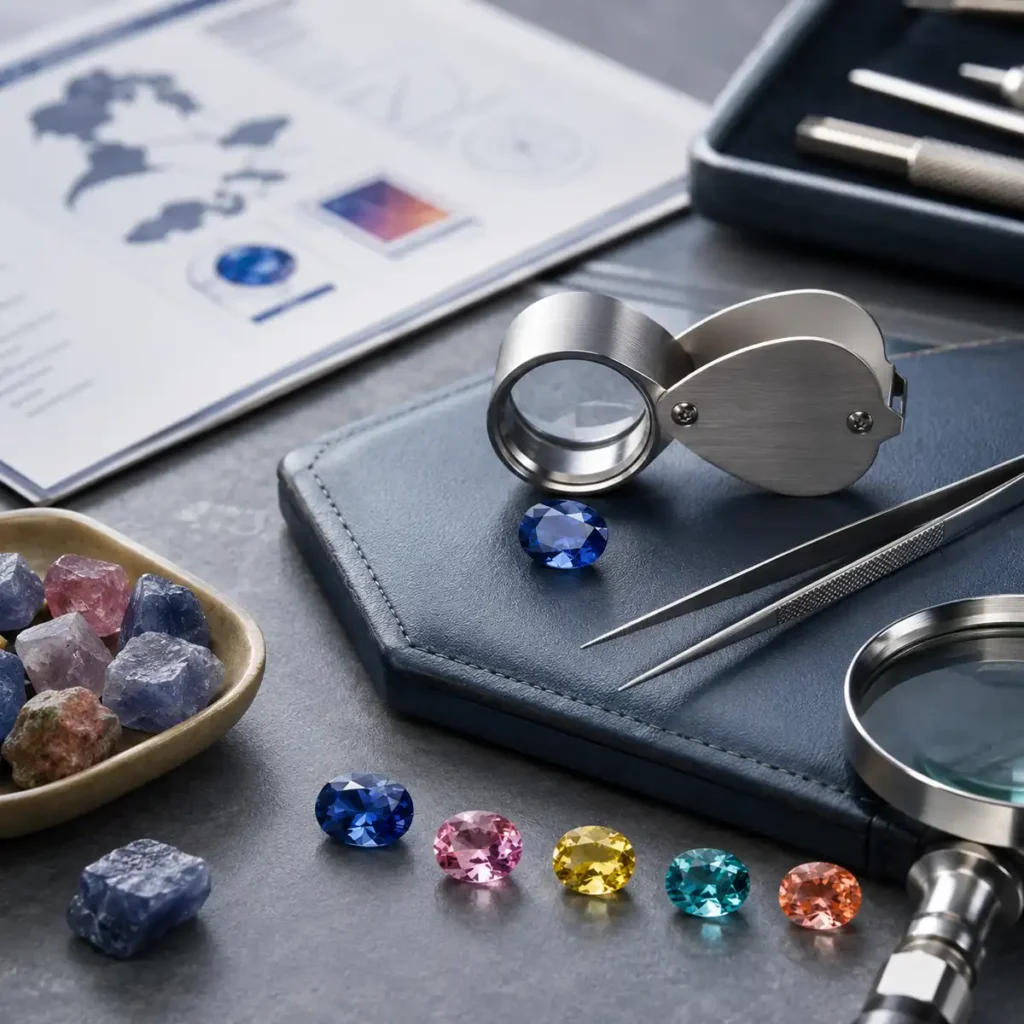
A sapphire is a gem-quality variety of corundum, an aluminium oxide mineral that crystallises in the trigonal system at high temperature and pressure over geological timescales. Pure corundum is colourless. The colour that defines a sapphire is the result of trace elements, principally iron and titanium for the classic blue, chromium for pink and padparadscha, vanadium for purple, and combinations of these for the green, yellow and teal varieties.
The most important number for an engagement ring buyer is the hardness. Sapphire scores 9 on the Mohs scale, second only to diamond at 10. In practical terms, this means a sapphire is harder than every other gem-quality stone you are likely to consider, including emerald, ruby’s softer cousins among the corundum family aside, topaz, tourmaline, and every garnet. It is harder than the steel of most kitchen knives. For daily wear on a working hand, sapphire is structurally an excellent choice, sitting closer to diamond in durability than to any other coloured gemstone.
Sapphire is also dense, which gives it visual weight. A 1-carat sapphire reads on the finger as slightly smaller than a 1-carat diamond because corundum is denser than carbon, so the same weight produces a marginally smaller stone. This is worth knowing before you commit to a carat figure.
The colour question and why origin matters
Sapphires occur in every colour of the visible spectrum apart from red, which is by tradition called ruby. The blue sapphire is the classic engagement choice, but pink, yellow, teal, padparadscha and green sapphires have all gained significant ground in the UK market over the past five years.
The most important variable in choosing a blue sapphire is the colour itself, and the trade has developed a vocabulary for it. Royal blue describes the most highly prized vivid medium-dark blue, traditionally associated with Burmese and Sri Lankan stones. Cornflower blue describes a softer, slightly lighter medium blue with a hint of grey, traditionally associated with Kashmir. Velvety describes the textural quality of the best Kashmir stones, where the colour appears to sit slightly within the stone rather than on its surface.
Origin matters in sapphire in a way it does not always matter in diamond. The geographic source affects colour, inclusion pattern, and value, and a properly graded sapphire from a recognised laboratory will state its origin where determinable. The principal sources are Sri Lanka, producing the largest volume of fine commercial and high-end stones, Madagascar, increasingly prominent and offering excellent value, Burma, historically the source of royal blue, and Kashmir, the rarest and most coveted source whose mines have produced very little since the early 20th century. A genuine Kashmir sapphire carries a substantial premium and should always be accompanied by a major laboratory origin report.
For a deeper look at how coloured stones are graded and certified relative to diamonds.
Heat treatment and what it means for the buyer
Almost all sapphires on the commercial market have been heat-treated. This is industry standard, has been practised for thousands of years in some form, and is fully accepted by the trade. Heat treatment improves colour saturation and clarity by dissolving fine rutile inclusions and stabilising the colour-causing trace elements. A heat-treated sapphire is not synthetic, not enhanced with chemicals, and not structurally altered. It is the same stone, with its appearance optimised through controlled temperature.
What matters to a buyer is disclosure. A reputable jeweller will tell you whether the stone has been heat-treated, and a major laboratory report will state this clearly. Unheated sapphires, particularly fine ones, command a significant premium because they are increasingly rare. A 2-carat unheated Sri Lankan royal blue sapphire with a major laboratory report stating no heat treatment will trade at multiples of an equivalent heated stone.
Beyond standard heat treatment, there are more aggressive enhancements that should prompt scepticism. Beryllium-diffused sapphires have been chemically altered at the surface, fracture-filled sapphires have had glass or polymer introduced into surface-reaching inclusions, and lattice-diffusion treatments produce surface colour over a paler core. These are not fine jewellery stones and should not be sold as such. A laboratory report will disclose all of these treatments. Insist on seeing one.
Sapphire engagement rings for daily wear
A sapphire engagement ring performs differently from a diamond in everyday life, and the difference is worth understanding before you commit.
In bright sunlight, a sapphire’s colour reads at its most saturated, and a well-cut blue or pink stone will return strong colour visible from across a room. In low indoor light, particularly warm tungsten, a sapphire’s colour reads slightly darker, and the colour may flatten relative to its daylight performance. A well-cut sapphire will still hold its colour, but the buyer who has only seen the stone under retail lighting may be surprised by how it looks at dinner. See your stone in daylight, in indoor light, and in candlelight before committing.
Sparkle in sapphire is different from sparkle in a diamond. Sapphire has a refractive index of around 1.76 compared with diamond’s 2.42, which means a sapphire returns less brilliance and less fire from the same cut quality. What it offers instead is colour, depth, and a particular optical character that the trade calls velvety in the best stones. The choice is not less than a diamond; it is different from a diamond.
In daily wear, sapphire is hard enough to handle the work. The stone resists scratching on most surfaces a hand encounters in a normal week. Cleaning is straightforward with warm water, mild soap, and a soft brush. The setting will need the same periodic prong-checking as a diamond ring, and the stone itself should be checked annually for any small chips or abrasions at the girdle.
Choosing the setting for a sapphire centre stone
The setting decision for a sapphire follows similar principles to a diamond engagement ring but with some specific considerations.
Claw settings work beautifully for sapphires and remain the most popular choice. The lifted profile shows the colour to maximum advantage and allows light to enter the stone from multiple angles. Six-claw settings suit round sapphires, four-claw or compass-set claws suit cushion and oval shapes.
Halo settings have a particular affinity with sapphires. A halo of small diamonds around a blue sapphire centre is the single most-requested coloured-stone configuration at Smith and Green and produces the classic look associated with the Princess of Wales engagement ring. The contrast between the coloured centre and the white halo intensifies the perceived colour of the sapphire and creates a setting that reads as substantial on the finger.
Bezel settings protect a sapphire well and suit modern minimalist designs. Because sapphire is harder than most metals, it will not be scratched by a bezel rim during setting, but a skilled setter is still essential to avoid stressing the stone at the corners of fancy shapes.
Pavé bands frame coloured-stone centres exceptionally well, particularly when the pavé is set in the same metal as the centre setting to create a continuous design line.
Fun fact: The British engagement ring tradition with sapphire centre stones predates the Crown Jewels by centuries, but the modern surge in sapphire popularity dates specifically to Prince Charles’s 1981 proposal to Lady Diana Spencer with a 12-carat Ceylon sapphire surrounded by 14 diamonds, the same ring now worn by the Princess of Wales.
What to ask before you commit to a sapphire engagement ring
Five questions will protect you and tell you whether the stone you are being shown is the stone you should buy.
What is the origin, and is there a laboratory report stating it? Origin affects value substantially, and a stone described as Kashmir or Burmese without paperwork should not be sold at the price of one with paperwork.
Has the stone been heat-treated, and is this disclosed in writing? Standard heat treatment is acceptable. Beryllium diffusion and fracture filling are not. The report must state the treatment.
What is the colour grade and the colour description in the report? Look for terms like vivid blue, royal blue, or in the case of padparadscha, specifically that designation, which is a regulated trade term.
Is the stone eye-clean? Sapphire is graded on inclusions differently from diamond, and small silk inclusions are normal and acceptable in fine stones. What you want is a stone with no eye-visible inclusions in the table.
What is the carat weight and the millimetre dimensions? Because corundum is denser than diamond, ask for the face-up dimensions in millimetres, not only the carat weight, so you can judge how the stone will read on the finger.
Where Smith and Green sit on sapphire engagement rings
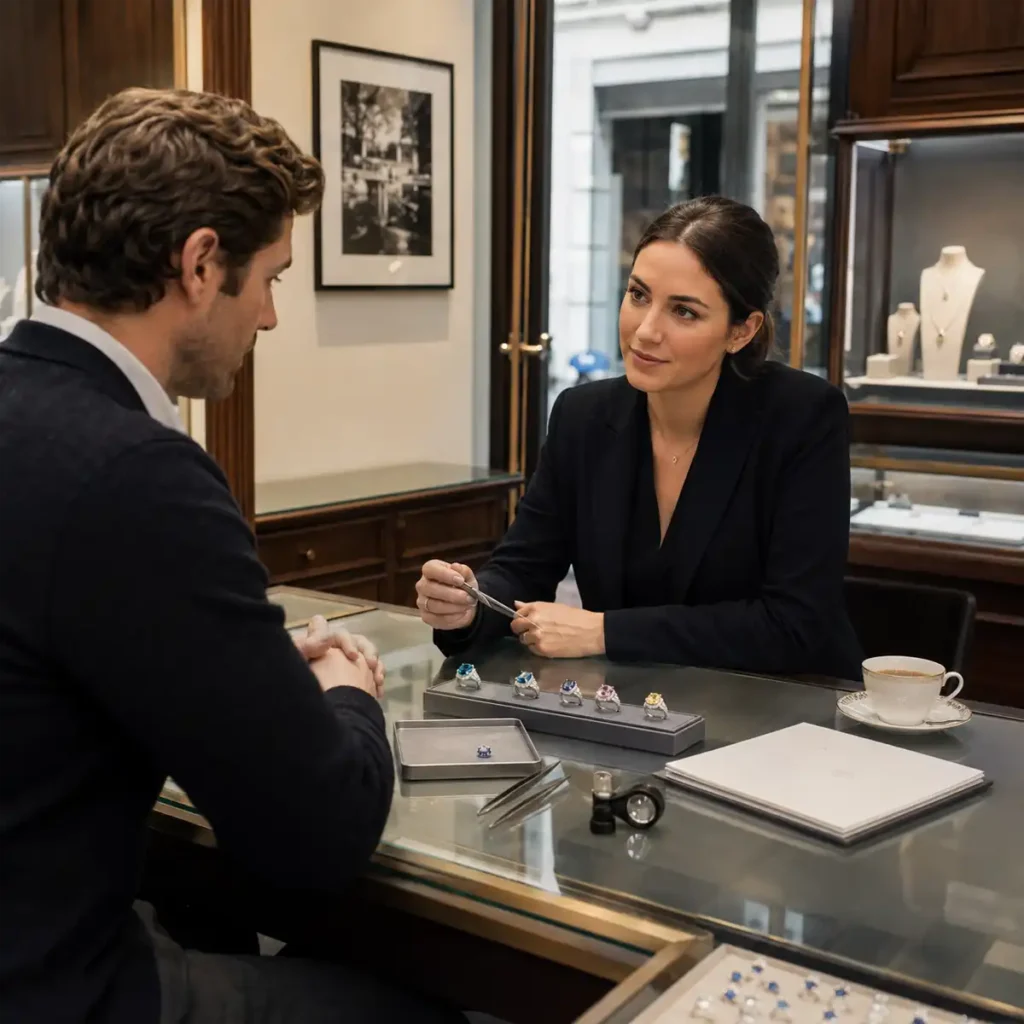
We hold a curated inventory of certified sapphires across the major colour ranges, sourced principally from Sri Lanka and Madagascar, with occasional Burmese and Kashmir stones where the paperwork supports the origin claim. Every sapphire above 0.50 carats sold at our 9 Hatton Garden showroom carries an independent laboratory report stating origin, where determinable and treatment in full. We will show you heated and unheated stones side by side so you can see the value difference for yourself, and we will set the centre stone in whichever configuration suits your design without prejudice toward halo, claw or bezel. A short walk from Farringdon Elizabeth line, the showroom keeps daylight-balanced lighting at the consultation desks specifically so that coloured stones are seen as they will appear in real wear, not under retail spotlights designed to flatter. To see how a sapphire centre stone might sit at a specialist showroom rather than a high-street chain.
Conclusion
A sapphire engagement ring is not a substitute for a diamond ring. It is a separate, considered choice with its own merits, its own market, and its own visual character. Sapphire suits the buyer who wants colour, who values durability, and who is comfortable with a stone whose origin story carries real weight. Before you commit, see the stone in three lighting conditions, read the laboratory report carefully for origin and treatment disclosure, and confirm the millimetre dimensions match what you expect on the finger. Book a consultation, allow 60 to 90 minutes, and bring any reference images of sapphire rings you have admired. Sapphire engagement rings reward buyers who arrive informed, and the information in this article is enough to start that conversation on the right footing.


