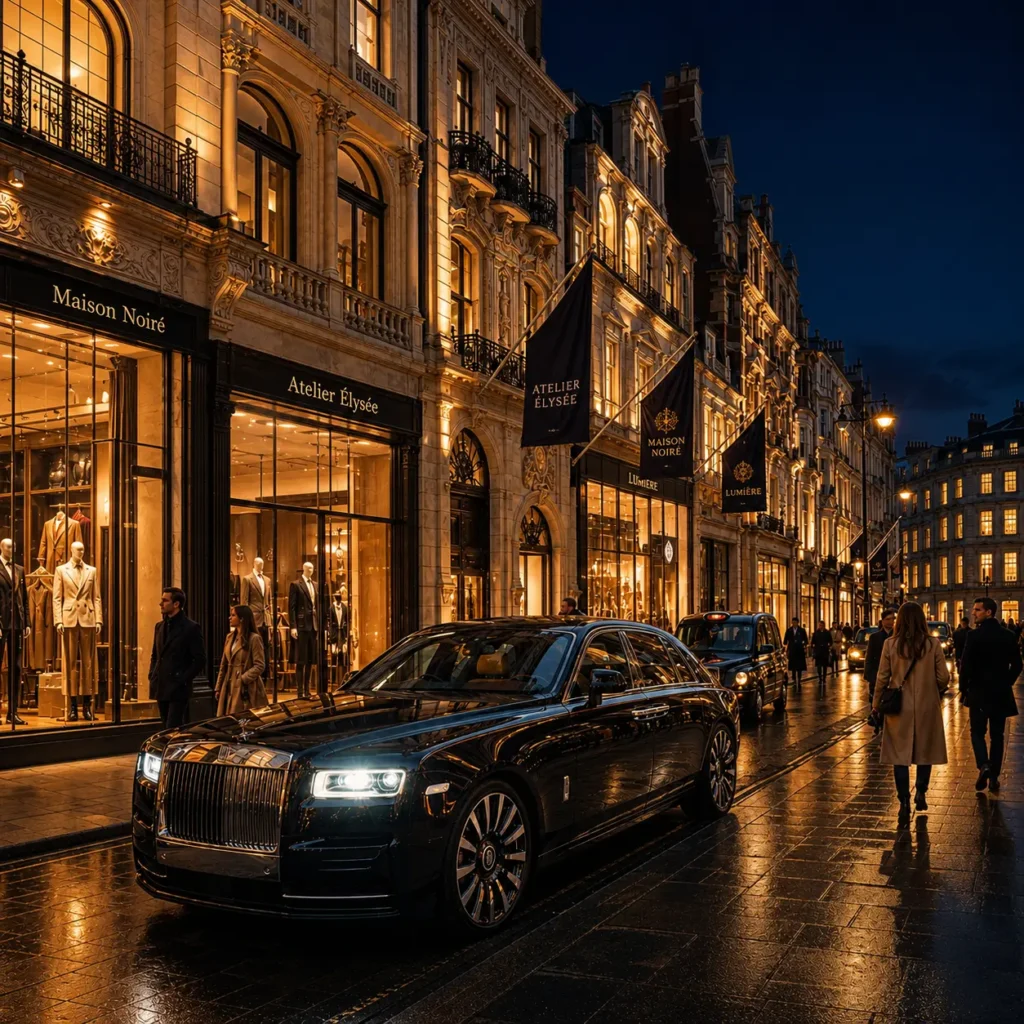
The Neighbourhood Behind the Doors
Behind the Georgian facades of Berkeley Square and the quiet length of Curzon Street, London built something that would travel far beyond the people inside those rooms. Mayfair in the second half of the twentieth century was a small district with an unusual concentration of old money, new fortunes, and discretion, and it became the place where the modern culture of table gaming took its recognisable shape.
The unmarked doors mattered. So did the geography: a few hundred acres between Hyde Park and Piccadilly where aristocrats, financiers, and the postwar social set moved within walking distance of one another. Wealth, proximity, and a shared appetite for high-stakes play converged in a single neighbourhood, and the results shaped how people gamble far past London.
The Clermont Club and John Aspinall
The most storied chapter belongs to the Clermont Club, opened by John Aspinall in 1962 at 44 Berkeley Square, a Grade I listed townhouse built in the 1740s to a design by William Kent. The Clermont became the most famous private gaming club in British history, and its style set a template that luxury rooms around the world still borrow: mahogany, candlelight, deep discretion, and a membership drawn from the heart of the establishment. Lord Lucan was a regular, as were James Goldsmith and Jocelyn Stevens, part of a circle later known as the Clermont Set. The game of the house was chemin de fer, a fast variant of baccarat played for sums that could rearrange fortunes in an evening.
The club’s reach extended well past its tables. It sat at the centre of the events surrounding the disappearance of Lord Lucan in 1974, an affair that fixed the Clermont in the public imagination far beyond gambling circles. According to historical accounts, the same rooms hosted early conversations among a group of investors whose methods anticipated what is now called private equity. Few private clubs anywhere have left a comparable mark on both finance and folklore.
Crockford’s and the Longer Lineage
Mayfair’s gaming culture did not begin with Aspinall. It runs back more than a century earlier to William Crockford, a fishmonger’s son who opened his club at 50 St James’s Street in 1828 and, through a combination of shrewdness and nerve, turned himself into host to the British aristocracy. Crockford’s is often cited as the prototype for the modern private gaming house, drawing peers and, reportedly, royalty across its threshold. The original closed in 1844, the year of its founder’s death, but the name proved durable. A later Crockford’s operated for decades in Mayfair, eventually settling on Curzon Street, and carried the tradition of exclusive, high-stakes play deep into the present era. From the beginning, the appeal was never only the cards. It was the social aspiration attached to being admitted at all.


The Gaming Act 1968
The turning point came with the Gaming Act 1968. Before it, much of Mayfair’s play sat in a grey area of quasi-legal private clubs. The Act introduced formal licensing, set out who could operate and under what conditions, and ended the loosely governed era that had let the great clubs flourish. Some formalised and continued; others closed. The legislation is widely regarded as one of the most significant gambling laws ever written, and other jurisdictions studied it closely when building their own frameworks. The atmosphere Mayfair had created became, from this point, something regulated and exportable rather than purely private.
Two of the games refined in these rooms went on to global careers. Chemin de fer carried an unmistakable glamour, helped by its association with James Bond; Ian Fleming knew London’s private gaming world intimately, and baccarat’s turn at the centre of that fiction cemented its image worldwide.
Blackjack, systematised later by the American industry in Las Vegas, drew its rules and much of its etiquette from European and specifically British tradition. Serious poker, too, was played in London clubs long before Texas Hold’em was standardised in Las Vegas in the 1970s, and long before its televised boom.
Where the Tradition Lives Today
The Mayfair of marble gaming rooms has thinned considerably. The Clermont at Berkeley Square has closed and reopened more than once since 2018, and its recent operation has been intermittent; the Ritz Club closed in 2020; and Crockford’s, after 195 years, shut its Curzon Street doors in 2023. The Aspinall lineage survives in altered form, the former Aspinall’s on Curzon Street having been acquired by Wynn Resorts and relaunched in 2025, while members’ venues such as the Playboy Club London on Old Park Lane still deal cards a short walk away.
Yet the more telling shift is that the trade no longer needs the buildings. The formats Mayfair spent generations perfecting now reach a global audience, and the most democratic continuation of that centuries-old tradition is the ability to play table games online from anywhere, with live dealer formats deliberately staging real croupiers in real time to recreate the atmosphere those private rooms first invented. What began behind unmarked Mayfair doors, reserved for a named few, has become something almost anyone can now sit down to.