
Walk into one of Mayfair’s members’ clubs on a Friday evening and the technology that runs the room stays politely out of sight. The booking that secured your table, the lighting tuned to the hour, the playlist shifting as the night deepens: all of it is engineered, yet none of it announces itself. That instinct, to let technology serve the atmosphere rather than overwhelm it, has become the quiet organising principle behind the way premium entertainment is changing.
For most of the past decade, the luxury sector treated digital tools as back-of-house plumbing. They handled reservations, membership records and payments, and that was the extent of it. The expectation has since shifted. Guests now arrive having already curated half the evening from their phones, and they expect the in-person experience to feel just as responsive. The result is a steady blurring of the line between the physical venue and the digital layer wrapped around it.
From screens to spaces
The clearest expression of this shift is the move from passive screens to immersive spaces. Concerts are an obvious example. Artists and promoters are building shows around volumetric capture and spatial audio, letting audiences feel closer to a performance whether they are in the room or watching a high-fidelity stream elsewhere. Museums and galleries, including several within walking distance of Bond Street, have leaned into projection mapping and mixed-reality overlays that turn a static exhibition into something closer to a walk-through narrative.
Deloitte’s media analysts have noted that the major growth cycles in entertainment have almost always been led by a new technology, from the arrival of online play to the smartphone explosion, and that audiences are now spreading their time more evenly across interactive and immersive formats rather than traditional broadcast, according to Deloitte’s 2025 Media and Entertainment Outlook. For a sector built on novelty and rarity, that is a meaningful signal.
What makes this relevant to the luxury market specifically is exclusivity. Immersive formats are not only about scale. They also make it possible to deliver something rare and tailored: a private virtual viewing room, a guided sensory tasting, a members-only digital event that mirrors the discretion of the physical club. The technology turns out to be very good at manufacturing a sense of occasion.
Hospitality learns to anticipate
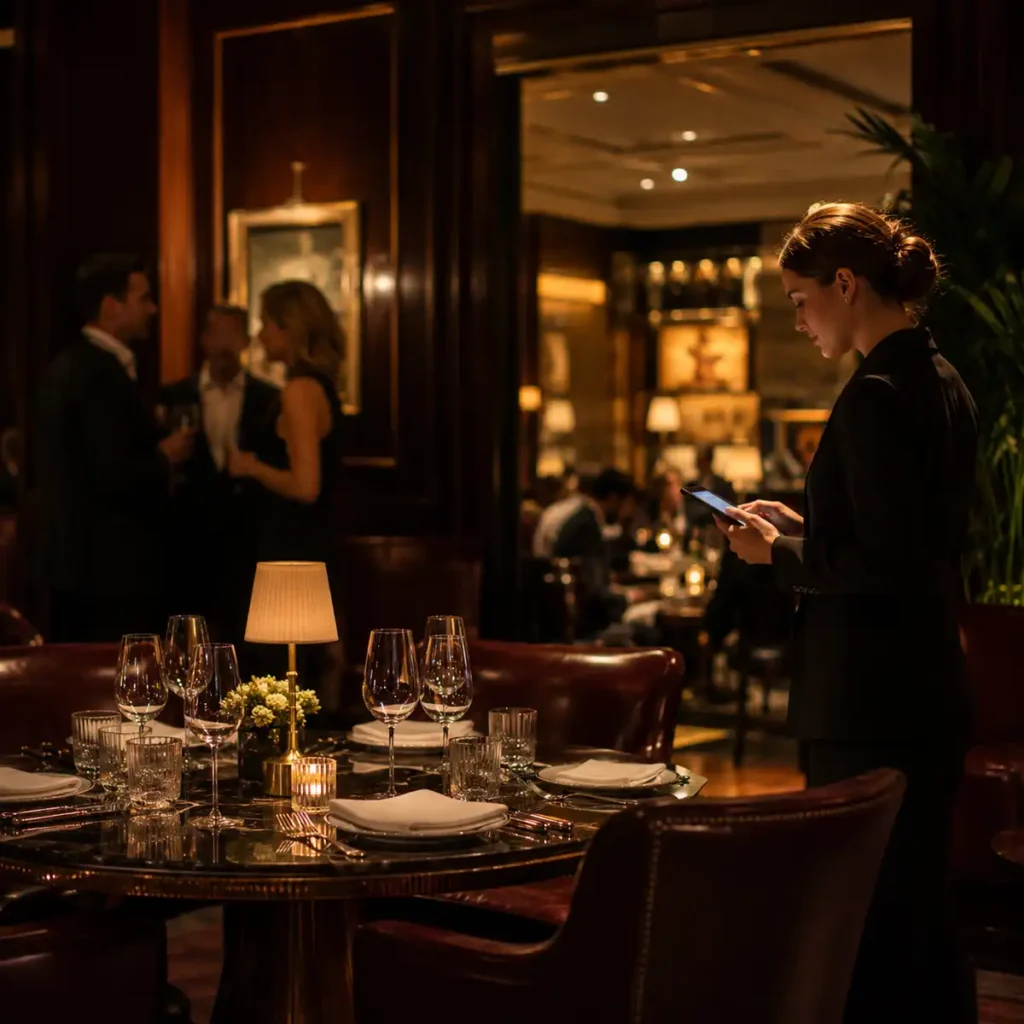
Inside hotels and restaurants, the same logic is producing subtler changes. Concierge services increasingly run on platforms that hold a guest’s preferences across visits, so a returning regular finds the right table, the right wine and the right room temperature without having to ask. Anticipatory service has always been the mark of a great Mayfair establishment. The difference now is that software does some of the remembering, which frees staff to concentrate on the human side of hospitality rather than the administrative one.
The district’s evening scene has adapted accordingly, blending old-world standards with digital convenience, as our guide to elite Mayfair nightlife sets out in more detail. Mobile booking, app-based membership and frictionless payment have become baseline expectations rather than novelties, even in venues that trade on their heritage.

The gaming parallel
Gaming offers one of the most advanced examples of immersion delivered at a high standard. Live dealer studios now stream real tables to players in real time, with professional hosts, multiple camera angles and instant interaction, recreating the texture of a physical gaming floor on a screen. Operators have gone further still, weaving live in-play activity and streams from land-based venues into their platforms so the experience at home mirrors the room itself. Across regulated European markets, these live and interactive formats have become some of the most active areas of product development over the past year (source: https://europeangaming.eu/portal/).
The parallel with hospitality is instructive. In both cases the aim is not to replace the in-person experience but to carry its atmosphere into a new setting, and to do so without cutting corners on quality. The venues and operators that succeed are the ones that treat immersion as a craft rather than a gimmick. The ones that fail tend to bolt technology on for its own sake, which guests notice immediately.
What comes next
The near future points towards greater personalisation rather than louder spectacle. Spatial audio, lighter mixed-reality hardware and smarter venue systems will keep narrowing the gap between what guests imagine and what they actually experience. For an area like Mayfair, where the product has always been a feeling rather than a transaction, that is a natural fit. The brands worth watching are those using these tools to deepen a sense of place, not to distract from it.
Luxury has never really been about owning the newest device. It is about attention, discretion and the impression that everything has been arranged precisely for you. Immersive technology, used with restraint, simply makes that impression easier to deliver and harder to forget.